0
View Post
MVC Virtual Networking Event: Relational Coordination in Healthcare Quality Improvement

MVC Virtual Networking Event: Relational Coordination in Healthcare Quality Improvement

In February, MVC hosted its first virtual networking event of 2026 with a special presentation on relational coordination by MVC Project Manager Emily Woltmann, PhD, MSW, and Richard Wylde, MSc, Deputy Director of Improvement at Leeds and York Partnership, National Health Service (NHS) Foundation Trust. With more than 45 attendees, the event introduced members to relational coordination, a framework that can be used to evaluate and strengthen collaboration and teamwork in healthcare settings. Following presentations, participants joined breakout groups to discuss the content and complete a case study activity, followed by a debrief and wrap up discussion. 

Overview of Relational Coordination  

Woltmann kicked off the event with an introduction to relational coordination, which was first introduced by Jody Hoffer Gittell as a mutually reinforcing process of communicating and relating for the purpose of task integration. She introduced participants to the relational coordination framework developed by Braneis University’s Relational Coordination Collaborative (RCC), which showcases how relationships and communication continuously reinforce each other in positive and negative ways. In relational coordination, the main components being considered are whether communication that occurs is happening in a frequent, timely, and accurate manner and is being used with the intention of problem-solving; while relational components reference shared goals and knowledge rooted in mutual respect. 

Relational coordination is a dynamic theory, where many areas influence each other. In addition to communication and relational components, the full framework (Figure 1) describes the types of structural, relational, and work process interventions that may impact communication and relationships to impact downstream outcomes. 

Figure 1. RCC’s Dynamic Theory of Coordination

flow chart

Structural interventions are implemented by leadership roles and include things like shared meetings, huddles, information systems, and boundary spanner roles that cross over multiple departments. Relational interventions focus on directly improving ways people relate to each other, such as cultivating safe spaces for discussion. Finally, work process interventions focus on workflows and sometimes use plan, do, study, act (PDSA) cycles for improvement.

Woltmann highlighted some of the methods available for measuring relational coordination, including a validated quantitative survey to measure role-based coordination between team members. The survey can help evaluate how well relational coordination is working between different roles. Another measurement tool that can be used is relational coordination mapping (Figure 2), which is a visual way to view responses from the relational coordination survey and summarize the strength of relationships between groups. It is designed to encourage deeper engagement and reflection among participants.

Figure 2. Measuring Relational Coordination: Relational Coordination Mapping

Relational Coordination Mapping using a line matrix

Woltmann explained that when relational coordination is working well and is strong, it supports organizations in achieving a wide range of desired performance outcomes such as quality, safety, efficiency, staff well-being, learning, and innovation.

The Maryland and Michigan DECIPHeR Project - Relational Coordination in Community Mental Health Settings

Woltmann also discussed lessons and insights she gleaned about relational coordination from the Maryland and Michigan DECIPHeR Project, which focuses on implementing interventions that decrease cardiovascular disease (CVD) risk factors in people with serious mental illness. Led by Dr. Amy Kilbourne, PhD, MPH, in the Department of Learning Health Sciences at the University of Michigan, and Dr. Gail Daumit, MD, MHS, at Johns Hopkins University, the project focuses on identifying effective interventions shown to address CVD risk factors in persons with a serious mental illness. This broader implementation trial is researching ways to implement a new intervention called IDEAL GOALS in behavioral health homes (BHHs).

While analyzing the qualitative data for this needs assessment phase of the project, Woltmann and colleagues became interested in using relational coordination to understand relational aspects of care coordination in the BHH context. The sample for this study included 14 sites across Michigan and Maryland, with 14 nurses and 32 frontline staff. Sites were given a qualitative designation of “consistently positive” relational coordination, “consistently negative” relational coordination, or “mixed” relational coordination.

Of the 14 sites, Woltmann said five had a consistently positive relational coordination level, six had a consistently negative level, and three had a mixed result. The research team found that sites with consistently positive relational coordination had a variety of structural factors in place to support RC. Boundary spanner roles were seen as particularly important in achieving good relational coordination, as they take on the role that crosses the gap in care for patients – in this instance community mental health staff to primary care providers. Results from the study indicated there were many kinds of strategies that sites used to develop functional RC, and that the most imperative component to building positive relationships was having a strong sense of trust.

Relational Coordination in Mental Health Services – The National Health System

Following Woltmann’s presentation, Richard Wylde, Deputy Director of LYPFT, provided participants with an in-depth look at how relational coordination is being utilized in his work at the National Health System (NHS) of England and emphasized how important coordination is in a large healthcare system. The NHS employs 1.5 million staff to care for roughly 1.7 million patients daily. With a tax funded healthcare model, each patient’s care is financially covered (£188 Billion per year) (Figure 3).

Figure 3. The English NHS in Numbers and Why Improvement Matters

Illustration of why improvement matters in healthcare

The NHS has a complex system of hospitals, primary care clinics, mental health clinics, and community services. Wylde is a part of the Leeds and York Partnership NHS Foundation Trust (LYPFT) which provides specialist mental health and learning disability services to the people in Leeds West Yorkshire, England. They have 48 locations, including 408 beds, see over 25,000 new patients, and have contact with over 270,000 people in the community per year.

Wylde shared that the NHS relationship coordination journey began with senior leadership who had previous experience with relational coordination, introducing the concept and promoting it to other leaders and the board. He recounted that there was slow organizational uptake of relational coordination theory within the system initially. However, as other leadership saw the benefits, they were able to implement strategies at other organizational levels.

Within the community mental health services system, the LYPFT program wanted to look at how young people transition to adult mental health services. They found that it was important to provide a safe space for players in the system to come together to better coordinate this process, and to be mindful of the many different perspectives and power imbalances present. One of the barriers they experienced, Wylde said, was the difficulty in balancing the need for human relationships and trust building timelines versus the systems' need for quick answers.

Wyle highlighted several key lessons learned through implementing relational coordination at multiple levels of a system, including:

  1. Governance at the board level can have limitations on time for developing a relational space
  2. Relational coordination worked best when senior leaders had a collectively shared understanding of what relational coordination was and how they could use it
  3. Relational coordination was more successful when it had clear framing and context to the program/service/team
  4. It was important for all levels to understand how the relational coordination dynamic functions at the smallest level of a system (between people)
  5. Relational coordination is both a relationship and a process
  6. Strong relationships enable strong processes and vice versa

Breakout Session Debrief

During the breakout session portion of the networking event, participants were guided through a patient case study that demonstrated how breakdowns in staff communication and relationships could negatively impact patient outcomes. The breakout groups had engaging conversations that focused on building trust, relational coordination interventions, explaining the “why” to help teams develop shared goals, understanding the impact of staff-to-patient ratios on communication, and other tools and frameworks that have helped teams improve their communication.

MVC was glad to highlight this topic and the expertise of these presenters to support shared learning and continuous improvement within healthcare teams. MVC welcomes presenters to share their expertise, success stories, initiatives, and solution-focused ideas with MVC members, which cultivates a community of peers looking to collaborate in a non-competitive space. Please reach out to MVC by email if you are interested in being a presenter or submit a presentation proposal online.

0
View Post
MVC Virtual Networking Event: Leveraging Claims Data for Rural & Critical Access Hospital Quality Initiatives

MVC Virtual Networking Event: Leveraging Claims Data for Rural & Critical Access Hospital Quality Initiatives

On August 21, 2025, MVC Coordinating Center hosted a virtual networking event providing members from rural, critical access, and acute care hospitals with an opportunity to make professional connections and discuss strategies for leveraging claims data. Twenty-three MVC members from twenty different hospitals and eight health systems participated in the ninety-minute event.

The event began with an ice breaker activity and a brief interactive quiz reviewing the number of and CMS requirements for rural and critical access hospitals (CAHs). This portion of the event concluded with a survey of MVC value metrics most relevant to quality improvement (QI) at rural and CAHs revealing most sites are focused on sepsis follow-up (Figure 1).

Figure 1. Most relevant MVC value metrics to QI at your site

The networking event continued with a presentation by MVC’s Engagement Manager Jessica Souva, MSN, RN, C-ONQS highlighting MVC’s history with critical access and rural hospitals and the addition of ED-based episodes. Starting in 2016, CAHs began joining MVC membership and today twenty-four different CAH sites are active MVC members.

Souva emphasized the need to better serve this group by understanding their unique challenges. She then shared unblinded data on hospital-level index emergency department (ED) visits with behavioral health ICD-10 code rates for 30-day ED-based episodes from January 1, 2021 to November 30, 2024. Prior to sharing the data, members were asked where they thought their hospital’s rate would fall compared to the MVC All average, most felt their rates would be higher than the average. After sharing the data, most members found their rates to be lower than expected.

Aggregate data for conditions with the highest ED episode and inpatient episode volumes across all rural and CAHs from January 1, 2022 to December 31, 2024 were also shared (Figure 2). Souva encouraged members to discuss opportunities for benchmarking and custom analytics during the breakout session with this data in mind.

Figure 2. Conditions with the highest ED and inpatient episode volumes

vertical bar graphs of conditions with the highest ED and inpatient episode volumes

The breakout discussions were structured to engage attendees in conversations about the challenges and strategies to address leveraging claims data for rural and CAHs. After breaking into two smaller groups, attendees were provided with three primary discussion prompts to reflect upon:

  1. Data Possibilities: What data sources and metrics are frequently utilized to determine outcomes and impact of process improvements in the inpatient or ED setting?

MVC members reported that various internal data platforms and benchmarking tools such as Vizient, Premiere, and Q-Centrix are used by critical access and rural health sites. They also noted frequently using metrics provided by various collaborative quality initiatives (CQIs) (e.g., HMS, MEDIC, etc.) and Medicare Beneficiary Quality Improvement Project (MBQIP) Core Measure sets to evaluate process improvements. When asked how MVC can optimize benchmarking for rural and CAHs, attendees explored options for comparing data with similar-sized sites and increased alignment between CQI pay-for-performance (P4P) metrics.

  1. Data Sharing: Which stakeholders are commonly engaged in determining strategies and indicators of successful QI initiative implementation?

The discussions in both breakout rooms highlighted the importance of involving clinical leads, physician champions, and quality improvement oversight boards for the success of QIs. One hospital noted that they additionally include an executive sponsor for each QI which they find helps to drive QI forward. Others noted a shift in culture towards encouraging ownership of QI implementation to front line staff. They noted that with adjustments to quality departments’ scope and capacity, quality leadership can focus more on the “why” versus the “how” of QI.

  1. Conditions & Follow-Up Care: Are there specific conditions currently focused on reducing ED return visits and/or inpatient readmissions?

Key conditions of focus identified by MVC members include readmissions, chronic obstructive pulmonary disease (COPD), congestive heart failure (CHF), pneumonia, sepsis and diabetes. When asked if the data shared today inspired interest in new conditions or processes to investigate in the future, members noted interest in continuing to explore the utilization of behavioral health in ED-based episodes.

Feedback from members on MVC’s August Virtual Networking Event included:

  • “I enjoyed participating and sharing during this event.”
  • “This was very helpful. I would love more meetings like this specific to critical access hospitals and small rural hospitals.”
  • “These networking events are always great and provide great insight into what is happening across the state. It allows us to share ideas but there is also a validation component that we are all experiencing a lot of the same challenges and barriers.”
  • “This was a great networking event. As a member of an organization going through multiple ‘changes’, it was awesome to see how larger acute or rural hospitals tend to their QI projects.”
  • “There was a lot of great dialogs about changing culture and how we approach quality improvement.”

MVC looks forward to hosting additional networking events in the future to increase collaboration and connection with MVC’s members. The next networking opportunity will be an in-person networking dinner on October 9, 2025, the evening before MVC’s Fall Collaborative-Wide meeting. If you are interested in attending, please register for this event here. Please note that space is limited.

0
View Post
MVC Virtual Networking Event: Collaborative Learning in Post-Discharge Follow-up for Sepsis Patients

MVC Virtual Networking Event: Collaborative Learning in Post-Discharge Follow-up for Sepsis Patients

On April 16, 2025, MVC hosted a virtual networking event providing members with an opportunity to make professional connections and discuss strategies for improving post-discharge follow-up for sepsis patients. Forty-six MVC members from thirty-three hospitals and seven health systems participated in the ninety-minute event. 

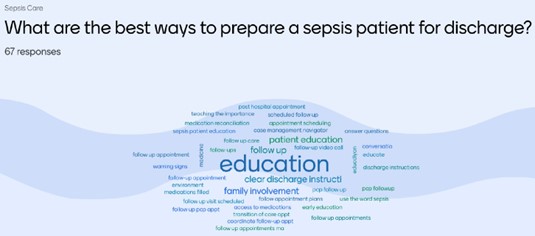
The event kicked off with an ice breaker activity (Figure 1) and an interactive quiz on common sepsis patient demographics, symptoms, and discharge care best practices.  

Figure 1. Best Ways to Prepare a Sepsis Patient for Discharge Poll

Best Ways to Prepare a Sepsis Patient for Discharge open poll

Prior to starting the breakout discussion groups, MVC’s Engagement Manager, Jessica Souva, MSN, RN, C-ONQS presented unblinded hospital-level 14-day follow-up after sepsis rates for 30-day inpatient episodes from July 1, 2023, to June 30, 2024. 

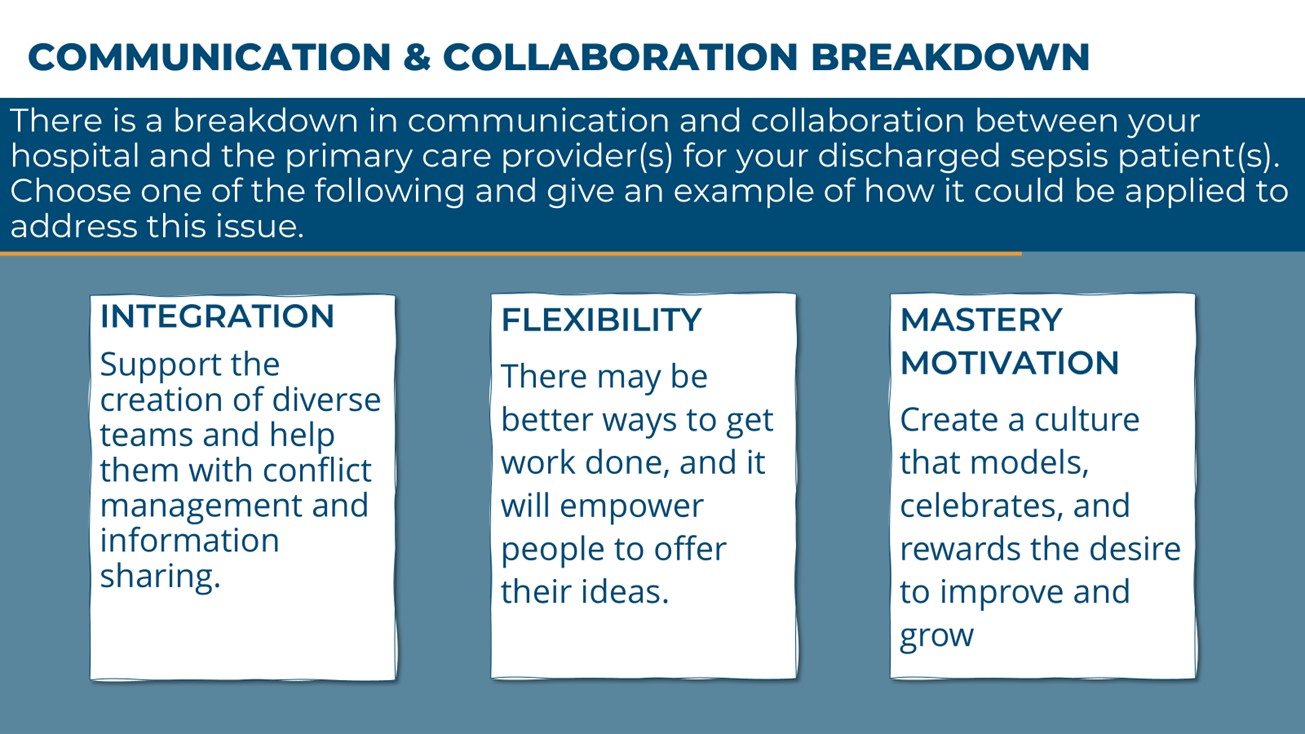
The breakout discussions were structured to engage attendees in conversations about challenges and strategies to addressing barriers in patient follow-up after sepsis. This goal was accomplished by providing groups with specific scenarios and types of approaches to improve follow-up after discharge for sepsis patients (Figure 2).

Figure 2. Challenges and Strategies to Address Barriers in Patient Follow-Up After Sepsis

Challenges and Strategies to Address Barriers in Patient Follow-Up After Sepsis

What challenges are MVC members facing related to follow-up after discharge for sepsis patients? 

MVC members reported that sepsis patients often face challenges in scheduling follow-up appointments, not knowing when to contact their provider for early warning signs and being readmitted before their scheduled post-discharge follow-up appointments. Contributing factors include lack of provider ability, incomplete patient or family education, and sub-optimal discharge dispositions.  

What are MVC members doing to improve their rates of follow-up after discharge for sepsis patients?  

During the breakout discussions, attendees shared that they are addressing the identified challenges through a multifaceted approach focusing on patient education, communication, resource access, team collaboration, and data evaluation. 

Patient Education and Empowerment 

  1. Discharge Paperwork: Include a phone number for patients to call with questions or concerns and to schedule follow-up appointments. This allows patients to seek follow-up care sooner. 
  2. Family Involvement: Educate and involve family members to facilitate follow-up care by ensuring they understand the importance. 
  3. Empowering Survivor Stories: Share stories from patient survivors through interviews, surveys, or patient advisory councils. These stories can be used to educate current patients, their families, and providers. 

Communication and Coordination 

  1. Care Coordinator/Nurse Navigator: Assign a care coordinator or nurse navigator as the point of contact post-discharge. Care Coordinators and Nurse Navigators can help patients understand factors influencing readmission and how to mitigate these factors. 
  2. Continuous Communication: Maintain open communication between inpatient and outpatient case managers regarding transitions of care. 
  3. “Call Back Crew”: Build a team to follow up with patients, reinforce education, and use call centers to identify trends and improve follow-up processes. 

Resource Access 

  1. Scheduling Follow-Up Appointments: When possible, schedule follow-up appointments before discharge. 
  2. Discharge Clinics: Block time for a dedicated provider to staff a clinic for patients who do not have or are unable to get an appointment with their PCP. This type of clinic can reduce return ED visits and readmissions by providing support, education, and resources. 
  3. Educate Staff About Under-utilized Resources: Local Area Agencies on Aging can facilitate access to free or low-cost services to improve the home setting for patients aged 65+. Many insurance providers, like Medicare Advantage/BCBSM provide additional support post-discharge with designated case managers.  

Team Collaboration and Internal Processes 

  1. Multi-Disciplinary Approach: Include care management and various therapies to support patient recovery. Ensure all patients receive a physical and occupational therapy evaluation to screen basic functional needs before discharge and determine the best future care setting. 
  2. Unified Team Message: Ensure therapy, physician, and care management teams provide a unified message to patients. 
  3. Improve Team Reliability and Training: Build internal trust and, consequently, patient trust. Provide physicians with training on how to conduct difficult discussions with patients and their families, ensuring patients understand their situation and the benefits of alternative approaches when recommended by medical professionals. 

Data and Evaluation 

  1. Patient Interviews and Surveys: Include a readmission nurse on the patient care team to interview readmitted patients and learn from their experiences.  The readmission nurse can act as a liaison between quality and hospital care teams, highlighting patients needing special attention and collecting feedback. 
  2. Retrospective Review: Complete a retrospective review of the patient’s journey to identify improvements needed in education and communication upon readmission for the same reason. 
  3. Care Transition Programs: Add sepsis patients to Care Transition Programs to trigger alerts for retrospective review of readmission cases and to identify improvement areas. 

What are members saying about the MVC April Virtual Networking Event? 

  • “Very fun and informational event. I like the smaller break out sessions to foster meaningful conversation and then bringing the ideas of the smaller groups to the entire group.” 
  • “Very well organized. I loved the interactive piece.” 
  • “I enjoyed the pre-break out group survey/quiz questions to help with engagement…it is less intimidating to speak up in the smaller groups than when everyone is in on large group.” 
  • “I enjoyed the networking aspect of this event and look forward to others in the near future. MVC Site Engagement Coordinators did a wonderful job facilitating this event and engaging the participants.” 
  • “It was reassuring to hear that many of the hospitals across the state are having the same issues and working on similar projects. It gave me a sense that my own hospital is on the right path.” 

MVC looks forward to hosting more virtual networking events throughout the year to increase collaboration and connection with MVC’s members. If your hospital or organization has a networking topic they would like to share, please email us. We would love to hear from you.