
0
View Post
CQI Spotlight: Michigan Oncology Quality Consortium

CQI Spotlight: Michigan Oncology Quality Consortium

Cancer care is not defined by treatments alone—it is measured by the experiences, quality of life, and outcomes of the people navigating the disease. Across Michigan, patients with cancer face complex clinical decisions alongside challenges that extend beyond the clinic, from treatment side effects to barriers in accessing supportive services. Through statewide collaboration, shared data, and a commitment to improving care delivery, the Michigan Oncology Quality Consortium (MOQC) is working to ensure that patients and their caregivers receive more consistent, compassionate, and high-value cancer care.

Established in 2009, MOQC was tasked with addressing oncology data that showcased significant variation in care outcomes as well as significantly higher costs compared to other areas of healthcare. One of 21 Collaborative Quality Initiatives (CQIs) sponsored by the Blue Cross Blue Shield of Michigan (BCBSM) Value Partnerships Program, MOQC’s aim is to improve access, value, and quality of care for all invasive cancers.

In addition to establishing cross-cutting measures that apply to all disease groups within oncology, MOQC’s work expanded to acknowledge and address the impact of non-medical drivers of health on patient outcomes, intentionally creating space for more patient, caregiver, and frontline voices to shape meaningful change and guide the evolution of cancer care in Michigan.

Services and Benefits for MOQC Members

MOQC provides access to resources and tools, quality improvement initiatives, partnerships, funding, and support that its membership of 54 oncology practices would not otherwise have available. Through collaborative-wide and regional meetings, MOQC fosters member networking, ongoing education on best practices and emerging topics, new publications, and collaboration opportunities. MOQC also meets with oncology practices individually to review their performance measures. For those needing additional support in any area, MOQC conducts root cause analyses in collaboration with the healthcare team and provides resources and consultation on their processes and progress.

Members also benefit from access to the Patient and Caregiver Oncology Quality Council (POQC), a robust and highly engaged patient advocacy group currently comprised of 30 members (Figure 1). POQC gives teams the opportunity to learn directly from the lived experiences of patients and caregivers and brings forward barriers to care that may not be visible in data alone. POQC also contributes to decision-making about quality measures and initiatives through their work on MOQC’s Measures and Steering Committees. Their voices help member practices stay connected to the heart of what they do as they work to help guide MOQC’s efforts toward fair, effective, and compassionate health outcomes across the state (Figure 2).

Figure 1. Patient and Caregiver Oncology Quality Council (POQC)

group photo

Figure 2. POQC Member Quote

A text-based graphic features a testimonial quote from a POQC member expressing gratitude for volunteer opportunities and the rewarding experience of being a valued patient voice for cancer care.

MOQC members also have the opportunity to establish integrated clinical pharmacist positions providing direct patient care through the Pharmacists Oncology Excellence Program in Michigan (POEM). This program, which has been in place for five years, encompasses 12 pharmacists who support 113 physicians across 28 practices. POEM has been associated with a variety of positive patient care outcomes and clinic time savings relating to clinical care activities.

MOQC’s Key Initiatives and Achievements

Through MOQC’s targeted initiatives, oncology care and outcomes are improving across Michigan. The Palliative Care and Hospice initiative aims to increase time enrolled in hospice to maximize benefits and quality of life for patients and caregivers. By creating tools for how and when to talk to cancer patients about palliative and hospice care (Figure 3), MOQC practices have seen hospice care enrollment improve from 44% in 2017 to 66% in 2024. In the words of a member physician,

“There is so much to help us do better at survival in cancer, and so many more new treatments out there, but the one thing that is often overlooked is – is it the right thing to do for the patient? So I was thrilled to see that MOQC is focusing on hospice. It’s so under looked in oncology these days.”

Figure 3. MOQC Hospice Conversation Guide for Physicians

An informational flyer titled "Hospice Conversations: Words That Make It Easier for Patients and Their Loved Ones" provides guidance on improving communication during hospice care.

A complimentary initiative, expanding palliative care access through a partnership with the Center to Advance Palliative Care (CAPC), provides training curriculum to advance practice providers (APPs) regarding primary palliative care, with intentional recruitment in areas of the state that have little-to-no palliative care currently. Those who complete the curriculum attain a certificate from CAPC and integrate primary palliative care into their ongoing care of patients and caregivers.

Patient quality of life is an important consideration in cancer care. To address nausea, a common side effect of chemotherapy that significantly impacts patients’ quality of life, MOQC launched a Chemotherapy-Induced Nausea and Vomiting (CINV) – Antiemetics initiative in 2020. The initiative works to increase prescribing of olanzapine to manage treatment-related nausea. Since the initiative began, prescribing of olanzapine has increased from 10% to the notable achievement of 60% in 2024, helping more patients have better treatment experiences. To help evaluate the impact of this effort, MOQC reached out to the Michigan Value Collaborative (MVC) to leverage its robust claims-based data. Together, MVC and MOQC evaluated the impact and value of this initiative in a 2023 impact and value assessment, and the two teams are in the process of refreshing that analysis with newer years of claims data.

Other initiatives include implementing a statewide gynecologic oncology virtual tumor board to support multidisciplinary learning, standardize care recommendations across practices, expand access to clinical trials, and expand perspectives for clinicians caring for patients throughout Michigan. MOQC helps optimize statewide treatment of advanced non-small cell lung cancer via an oncology stewardship initiative focused on improving biomarker testing across the state and increasing education around targeted therapies.

In addition to centering patient voices through POQC and many other MOQC accomplishments, a major achievement of MOQC is the development of a comprehensive Excellence in Quality Certification program that recognizes oncology practices providing high-quality and high-value care. Eligibility criteria include a site visit to ensure safe practices regarding anticancer therapy, measure performance, medical record review, and policy review. All criteria measure policy and practice to validate that oncology care is guideline-concordant and recognizes substantial decreases in variations in care and in costs of care (Figure 4). A key component of the certification is creating an action plan to close non-medical gaps in healthcare, ensuring all cancer patients in Michigan have the same access to high quality care. Fourteen out of MOQC’s 54 practices were certified in 2024, and 23 practices pursued certification in 2025.

Figure 4. MOQC Excellence in Quality Certification Criteria

A screenshot of a certification guideline document titled "MOQC Excellence in Quality Certification," outlining required elements for certification in oncology quality.

MOQC is proud of its commitment to addressing the non-medical needs of patients and caregivers through the POQC and the Excellence in Quality Certification program. Additional ways MOQC centers this aspect of patient care is by endeavoring to provide patients with increased access to supportive services and resources, including standardizing screening for non-medical needs, integrating referrals to Michigan 2-1-1 into electronic medical records (EMR), providing meals to patients who are currently food insecure and receiving anticancer therapy (plus up to one caregiver per patient), and facilitating financial navigation training for interprofessional members of oncology care teams. Non-medical patient needs and gaps in care are also being addressed through MOQC’s stewardship initiative, which aims to improve the use of systemic anticancer therapy with the goal of enhancing patient health outcomes while reducing financial strain on patients. In addition, MOQC conducts multivariate analyses of its measures annually to find gaps in care based on demographic categories. These analyses allow MOQC to review variation among practices and collaborate individually with them as needed to close gaps.

Looking Ahead: Continuing to Drive Whole Team Collaboration

MOQC’s work offers a reminder that improving oncology care often requires thinking beyond traditional approaches. By weaving patient and caregiver experiences into the fabric of their work, MOQC is able to look for gaps in care, prompt new questions, and reshape how they understand quality. MOQC’s initiatives and learning opportunities (such as interprofessional development sessions, the statewide tumor board, the palliative care certificate program, and addressing non-medical needs) are shaped with recognition that there is a whole team involved in the patient care related to MOQC’s quality measures. MOQC invites practices to engage with quality improvement in ways that expand perspective and challenge existing healthcare power dynamics. Through this multifaceted approach, MOQC is always striving to look for a deeper partnership with all of the people most affected by the outcomes.

The BCBSM-funded CQIs play a crucial role in driving healthcare quality improvement in Michigan. MVC is excited to continue highlighting the innovative contributions of individual CQIs and the ways in which MVC’s data are supporting high-value care initiatives across the portfolio. Please reach out to MVC by email if you are interested in learning more.


0
View Post
MVC Evaluates Impact of MOQC Antiemetic Initiative on Healthcare Utilization During Chemotherapy

MVC Evaluates Impact of MOQC Antiemetic Initiative on Healthcare Utilization During Chemotherapy

Chemotherapy-Induced Nausea and Vomiting (CINV) is among the most feared side effects of chemotherapy among cancer patients. It impairs the patient's quality of life and also adds to the morbidity and cost of therapy. That is why the Michigan Oncology Quality Consortium (MOQC)—a physician-led, voluntary collaborative of medical and gynecologic oncologists who work to improve the quality and value of cancer care in Michigan—initiated its Antiemetic Initiative. Through this initiative, MOQC supports participating oncology practices in aligning with current guidelines for use of prophylactic antiemetics, including olanzapine, in patients receiving chemotherapy. The Michigan Value Collaborative (MVC) recently partnered with MOQC to evaluate the impact of this initiative and estimated a cost savings of $334,095 across the course of chemotherapy from the increased use of olanzapine and decreased inpatient admissions in this cohort of patients.

Olanzapine is underused in patients receiving high-emetic-risk chemotherapy, despite evidence of efficacy and good patient tolerance (Navari et al., 2016). Olanzapine is a long-used medication (originally in higher doses for the treatment of psychosis) that is highly effective at decreasing nausea and vomiting. Uptake of olanzapine has been low, however, in part due to oncologists' lack of familiarity with the medication, lack of awareness or agreement with the guidelines, and lack of olanzapine inclusion on prepopulated order sets. The current labeling of olanzapine as an antipsychotic poses an additional barrier since this labeling generates additional concerns about stigma and side effects among patients. A benefit to this medication, in addition to its effect on nausea and vomiting, is its low cost compared with other medicines used to prevent the side effects of chemotherapy; the cost for each pill is about 25 cents.

Practices participating in MOQC’s Antiemetic Initiative receive performance data and baseline assessments in the area of CINV guideline adherence, support in identifying gaps in care and quality improvement measures, and resources for provider and patient education. To help evaluate the impact of this work on guideline-concordant olanzapine use, MOQC first reached out to MVC in 2022 to leverage its robust claims-based data. MOQC hypothesized that patients treated in medical oncology practices with low rates of olanzapine prescribing would have higher rates of healthcare utilization, including hospitalizations, emergency department (ED) visits, and unplanned outpatient visits between treatment cycles. The goal of this analysis was to estimate the initiative's overall impact on healthcare utilization for breast cancer patients undergoing chemotherapy as well as any related cost savings that improved the value of care delivery.

Methodology

The cohort for this analysis was comprised of female patients with a 90-day claims-based MVC episode of care for lumpectomy or mastectomy in 2016-2021 who received combination chemotherapy with doxorubicin and cyclophosphamide as either neoadjuvant or adjuvant chemotherapy. The cohort included patients covered by Blue Cross Blue Shield of Michigan (BCBSM) PPO Commercial, BCBSM PPO Medicare Advantage (MA), Blue Care Network (BCN) HMO Commercial, BCN HMO MA, and Medicare Fee-For-Service. The resulting MVC analysis included episodes for 1,891 patients who had a breast cancer resection, received both chemotherapy drugs on the same day, and were attributed to a MOQC provider/practice. Patients were attributed to 45 of MOQC's participating practices.

Practice-level olanzapine data collected by MOQC was then used to assess whether each patient's first chemotherapy receipt was during a time when their attributed practice had high or low prescribing rates of olanzapine. The threshold for high versus low prescribing at a particular practice was set at a 25% prescribing rate. Once a practice reached 25% prescribing rates of olanzapine in MOQC's data, that practice was considered to have "high" olanzapine prescribing rates in all subsequent months for this analysis. Using that distinction of whether the practice was a high or low prescriber during the course of the patient's chemotherapy regimen, MVC compared post-chemotherapy healthcare utilization among patients treated by high- versus low-prescriber practices. Sub-analyses further restricted the cohort to patients attributed to a practice that ever became categorized as having high olanzapine prescribing rates. When limiting the analysis to practices that became high prescribers at any point, the cohort was narrowed down to patients attributed to 15 MOQC practices.

Limitations

The nature of claims data limited MVC's ability to identify patients attributed to participating oncologists at MOQC practices; the requirement of each patient in the cohort having a MOQC provider NPI on one of their claims reduced the analytic cohort to a smaller size than what would be seen in clinical data. Another limitation is that the findings may include period effects not controlled for in this analysis. Practice behavior and availability of inpatient beds may have differed between when a practice was a low olanzapine prescriber compared to when they began prescribing olanzapine at a higher rate. Finally, payment calculations included in this analysis are limited to dollars saved among the attributed claims-based population and, therefore, do not reflect savings that may be attributed to olanzapine use among the broader population of interest.

Impact & Next Steps

A key finding in the analysis included a significant difference in healthcare utilization across the course of chemotherapy among patients treated by high olanzapine prescribing MOQC practices compared to when they had low olanzapine utilization. Among the patients with cancer who received their first cycle of chemotherapy when their provider's practice had a high prescribing rate (≥25%), 10% were hospitalized (Figure 1). This inpatient admission rate was significantly lower than for those patients undergoing chemotherapy regimens at practices with low olanzapine prescribing rates, 15% of whom were hospitalized (p=0.02). This finding was based on a subset of patients attributed to practices who eventually became high olanzapine prescribers during the study period (922 patients at 15 practices).

Figure 1. Rates of Inpatient Admission Across Patients' Course of Chemotherapy, by Practice's Utilization Rate of Antiemetics at the Start of Chemotherapy (N=922)
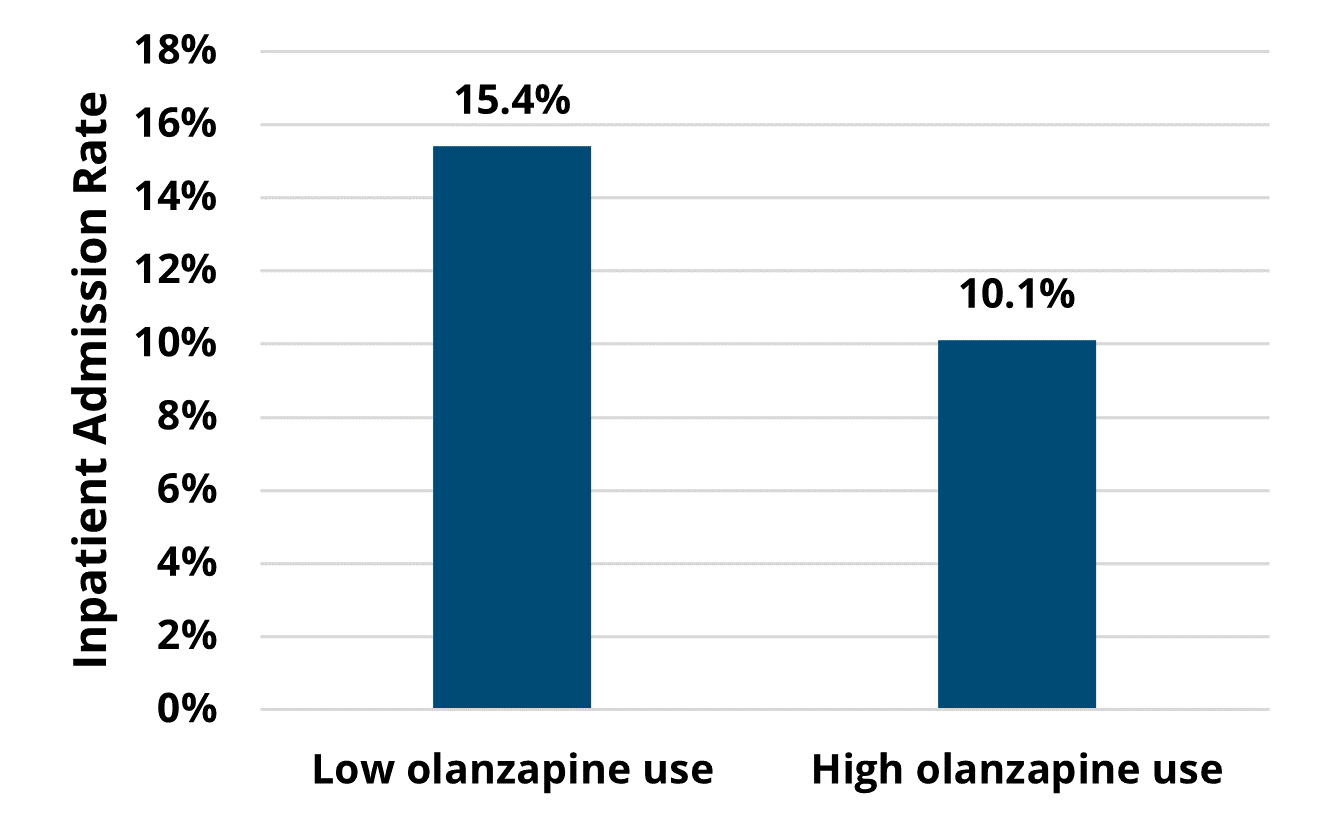
This analysis further discovered a significant difference in the percentage of patients who had either an ED visit or inpatient admission. Of the patients receiving chemotherapy at MOQC practices, fewer patients at high-prescribing practices had either an ED visit or inpatient admission (19%) across the course of their treatment compared to patients receiving care at low-prescribing practices (26%).

MVC estimated a cost savings of $334,095 across the course of chemotherapy from the increased use of olanzapine and decreased inpatient admissions in this cohort of patients. Dollars saved were calculated by taking the number of patients whose chemotherapy began when their practice was a high prescriber (525), multiplied by the difference in the percentage of patients with an inpatient admission across the course of chemotherapy attributed to practice antiemetic prescribing rate (5.3%), multiplied by the average price-standardized payment for an inpatient admission during a 90-day episode of care among breast cancer resection episodes for the included payers ($12,007).

This analysis demonstrated further evidence that the use of prophylactic olanzapine is an effective strategy for managing CINV-related ED visits or hospitalizations. It furthermore identified tangible CQI impact in the form of patients who underwent breast cancer treatment being less likely to visit the ED or be hospitalized over the course of their chemotherapy regimen, as well as in the form of dollars saved on facility inpatient costs across the course of chemotherapy. Ongoing work will continue to support practices to make changes in the use of olanzapine, not only in patients receiving combination therapy with doxorubicin and cyclophosphamide but also in other high-emetic-risk regimens.

MVC’s expertise and data frequently result in partner projects like this; MVC completed a number of CQI impact assessments last year, as well as several more so far in 2023. MVC also participates in collaborative activities with peer CQIs through new condition and report development, data analysis and metric consultation, and data matching exercises that pair clinical and claims-based data. To request a copy of any of MVC’s completed CQI impact assessments, please contact the MVC Coordinating Center.