Off
View Post
Hospitals Receive PY 2026 Mid-Year Scorecards for MVC Component of BCBSM P4P Program

Hospitals Receive PY 2026 Mid-Year Scorecards for MVC Component of BCBSM P4P Program

Earlier this month the Michigan Value Collaborative (MVC) distributed mid-year scorecards for Program Year (PY) 2026 of the MVC Component of the Blue Cross Blue Shield of Michigan (BCBSM) Pay-for-Performance (P4P) Program. PY 2026 marks the first year of the two-year (PY 26-27) P4P cycle, and includes Medicaid claims as well as the newly introduced health outcome variation measure in the scoring. This report provided hospitals with their current standing for PY 2026.

Each participating hospital received a mid-year score out of a total of 10 points, including 0 to 3 points for their selected total episode payment metric, 0 to 4 points for their selected value metric, 0 to 1 point for health outcome variation measure and 0 to 2 points for completed eligible engagement activities. PY 2026 scores achievement and improvement points for each metric using index admissions from 2025 performance year data against admissions in 2023 as the baseline year. Hospitals are awarded the higher of their achievement and improvement point scores.

The performance data timeframes included in mid-year PY 2026 scoring were index events 1/1/2025 – 12/31/2025 for BCBSM PPO Commercial, BCBSM Medicare Advantage (MA), BCN HMO Commercial, BCN HMO MA, Medicaid and index events from 1/1/2025 – 6/30/2025 for Medicare FFS. For the health outcome measure, the performance data included were index events from 1/1/1015 – 6/30/2025 to reflect the most recent date range for all payers. The engagement points accrued represent all completed activities from 1/1/2026 – 9/2/2026. All scores are subject to change in the final scorecards as the remaining 2025 performance data becomes available and additional 2026 P4P engagement activities are completed and recorded for this year.

Figure 1 illustrates the current distribution of total points out of 10 across the collaborative. The average points scored across the mid-year scorecards was 5.2 out of 10 and ranged between 0.5 and 10 points. This average is 1.5 points lower than the average points scored at the conclusion of PY 2025.

Figure 1. PY26 Mid-Year Distribution of Total Points Out of 10 Across the Collaborative

Dot plot ranks MVC Hospitals participating in PY26–27 P4P Program by PY26 mid-year score, with scores ranging from roughly 0.5 to 10. Blue hospital markers rise steadily across rankings, while an orange horizontal line marks mean and median at 5.2.

Figure 2 illustrates the breakdown of scoring on average by each program component (i.e., episode spending metric, value metric, health outcome variation measure and engagement points). Hospitals could earn up to three points for their episode spending, four points for their value metric selections, one point for health outcome variation measure and up to two points for engagement activities completed in 2026. Across collaborative, the average points scored for episode spending and value metrics were 1.0 point, and 2.2 points respectively. For the newly introduced health outcome variation measure, the average was 0.6 points and the average for engagement activities was 1.4 points.

Figure 2. PY26 Mid-Year Scoring on Average by Each Program Component

Bar chart showing average points scored across hospitals by category, with y-axis ranging 0–10 points. Blue bars show Episode Spending 1.0/3, Value Metrics 2.2/4, Health Outcome Variation 0.6/1, Engagement 1.4/2, and Total Points 5.2/10.

Figure 3 illustrates the breakdown of the average points by episode spending conditions. Coronary Artery Bypass Grafting (CABG) and Congestive Heart Failure (CHF) were both the highest scoring episode spending conditions with an average of 1.3 points, and this was followed by chronic obstructive pulmonary disease (COPD) with 1 point. The lowest scoring episode spending condition was pneumonia with hospitals earning 0.4 points on average.

Figure 3. PY26 Mid-Year Average Points by Episode Spending Conditions

Bar chart compares average points scored across episode spending conditions: CABG 1.3, CHF 1.3, COPD 1.0, and PCI 0.4. Blue patterned bars use a 0–3 vertical scale, with mean and median both marked as 1.0.

Figure 4 illustrates the breakdown of average points by value metrics. Consistent with PY 2025, the highest scoring value metric was preoperative testing with 3.5 points, followed by 90-day cardiac rehabilitation after CABG with 3.0 points. All follow up metrics had an average score of below 2 points with the lowest scoring value metric being 14-day follow up after COPD with 1.1 points.

Figure 4. PY26 Mid-Year Average Points by Value Metrics

Bar chart compares average points scored across value metrics for preoperative testing and follow-up categories. Dark blue bars decline from 3.5 for preoperative testing to 1.1 for 14-day follow-up after COPD, with mean 2.2 and median 2.0 marked at upper right.

These PY 2026 P4P mid-year scores are subject to change as new data is added. The final scores will be distributed after all 2025 claims are incorporated into the calculations. The full methodology for this program cycle can be found in the PY2026-2027 technical document. Hospitals can also track their score via the P4P PY 2026-2027 dashboard reports on the MVC registry, which provides all relevant scoring information for both improvement and achievement points. These registry reports can be filtered by selected conditions/metrics to make tracking of P4P points easier. You can also contact the MVC Coordinating Center by email for a walkthrough of your hospital’s PY 2026 mid-year scorecard or P4P registry reports.

Off
View Post
Hospitals Receive PY25 Mid-Year Scorecards for MVC Component of BCBSM P4P Program

Hospitals Receive PY25 Mid-Year Scorecards for MVC Component of BCBSM P4P Program

Last month the Michigan Value Collaborative (MVC) distributed mid-year scorecards for Program Year (PY) 2025 of the MVC Component of the Blue Cross Blue Shield of Michigan (BCBSM) Pay-for-Performance (P4P) Program. This report provided hospitals with their current standing for PY 2025. It also included a preview of measure scoring for the new health outcome variation measure that will be worth one point in PYs 2026-2027.

Each hospital received a mid-year score out of a total of 10 points, including 0 to 4 points for their selected total episode payment metric, 0 to 4 points for their selected value metric, and 0 to 2 points for completed eligible engagement activities. PY 2025 scores achievement and improvement points for each hospital’s selected episode spending conditions and value metrics using index admissions from 2024 performance year data against admissions in 2022 as the baseline year. Hospitals are awarded the higher of their achievement and improvement point scores.

The performance data timeframes included in mid-year PY 2025 scoring were index events 1/1/2024 – 12/31/2024 for BCBSM PPO Commercial, BCBSM Medicare Advantage (MA), BCN HMO Commercial, BCN HMO MA, and index events from 1/1/2024 – 6/30/2024 for Medicare FFS. The engagement points accrued represent all completed activities from 1/1/2025 – 7/31/2025. All scores are subject to change in the final scorecards as the remaining 2024 performance data becomes available and additional 2025 P4P engagement activities are completed and recorded for this year.

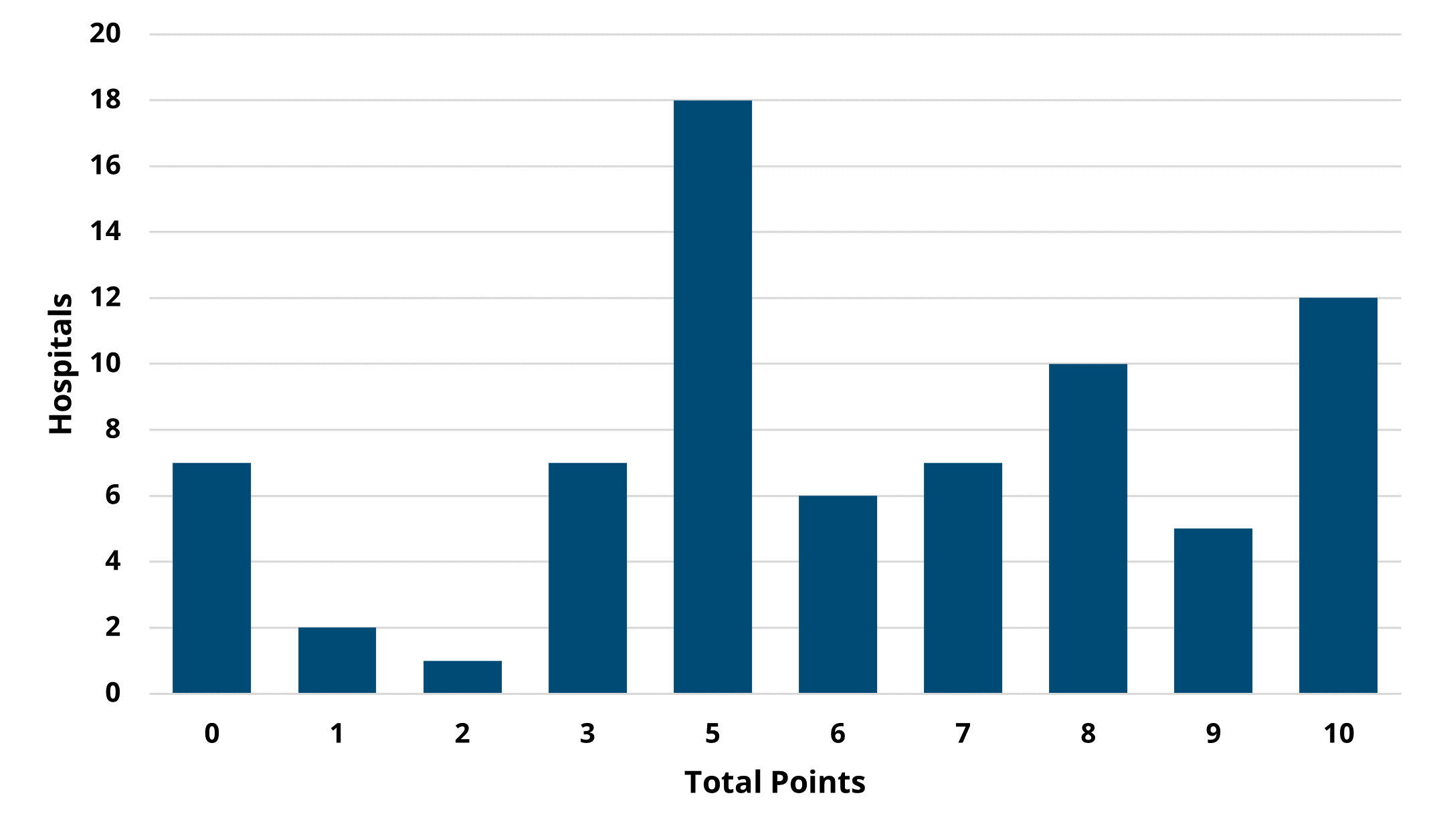
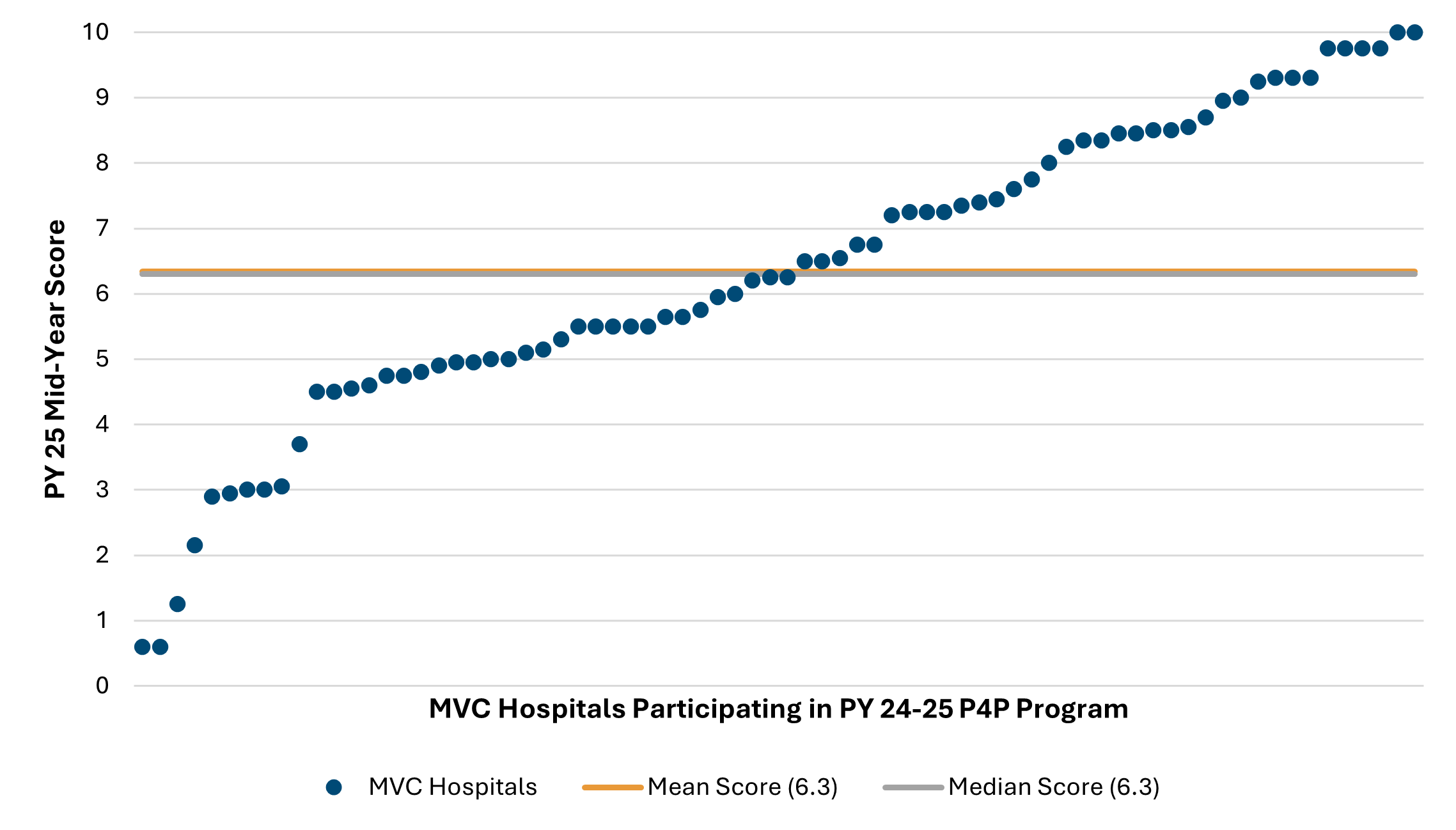
Figure 1 illustrates the current distribution of total points out of 10 across the collaborative. The average points scored across the mid-year scorecards was 6.3 out of 10. This average is 0.3 points lower than the average points scored at the conclusion of PY 2024.

Figure 1.

dot graph

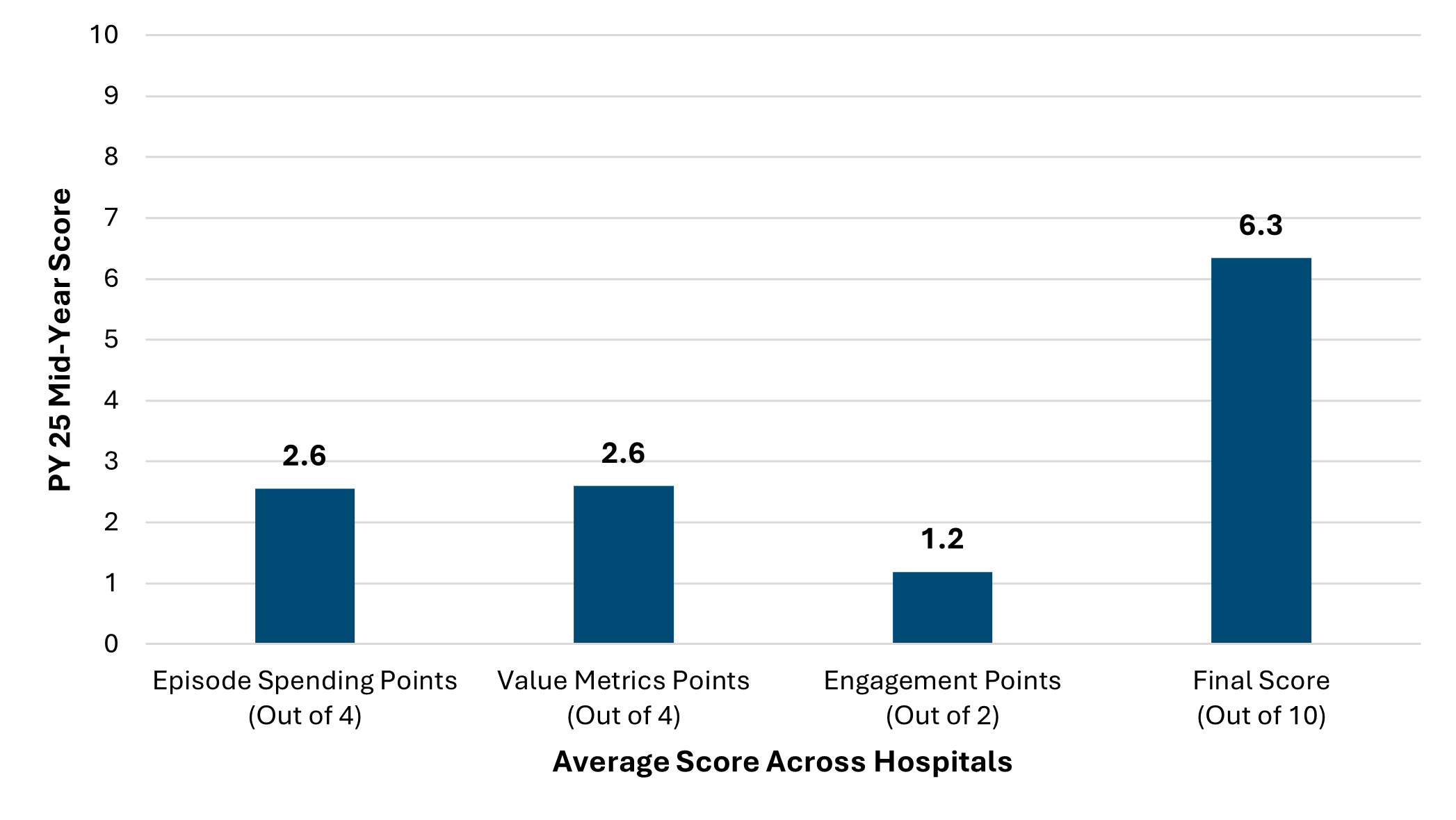
Figure 2 illustrates the breakdown of scoring on average by each program component (i.e., episode spending metric, value metric, engagement points). Hospitals could earn up to four points for their episode spending and value metric selections, and up to two points for engagement activities completed in 2025. Across the collaborative, the average points scored for both episode spending and value metrics was 2.6 points, and 1.2 points for engagement activities.

Figure 2.

vertical bar chart of average score across hospitals for episode spending metric, value metric, engagement points

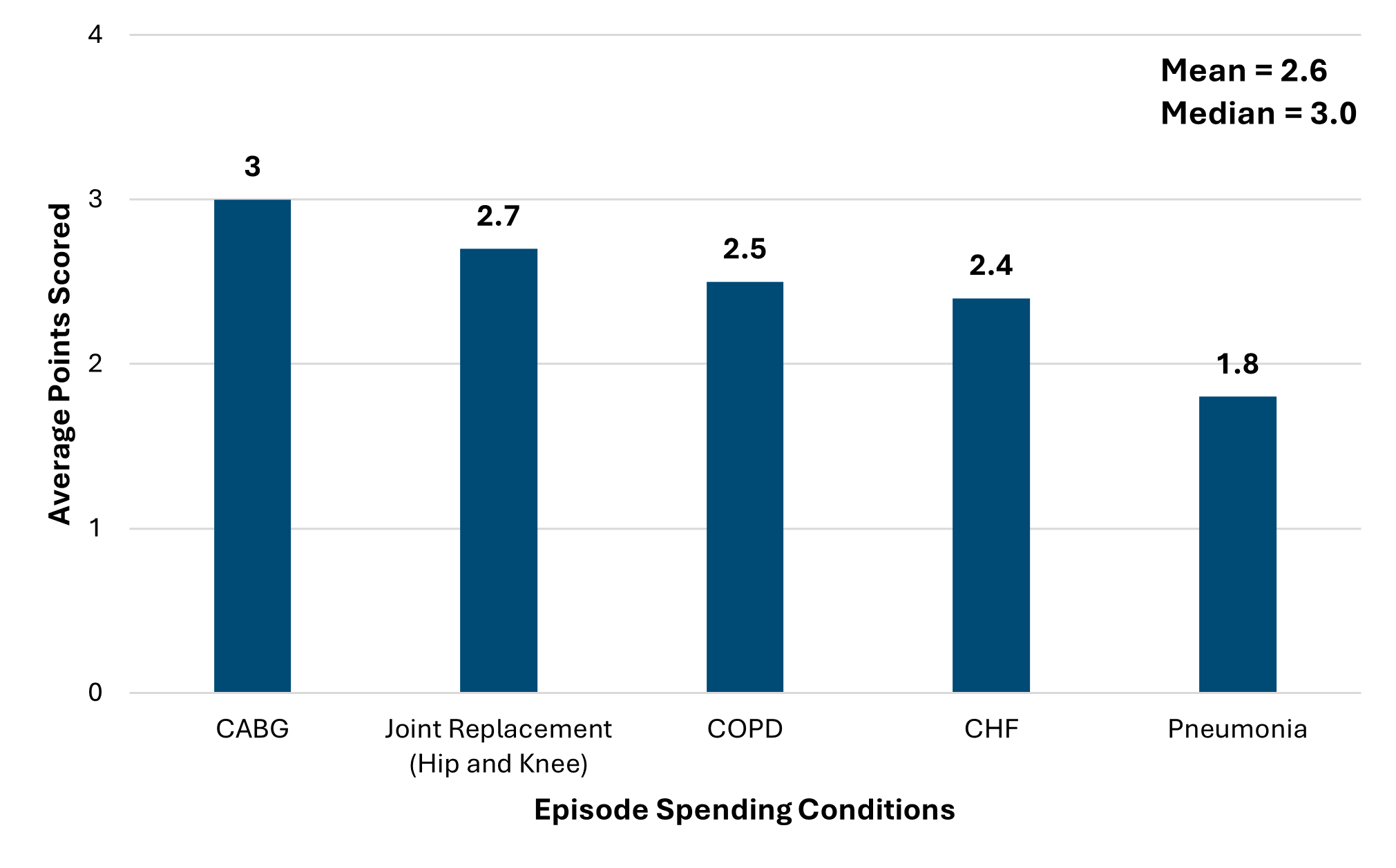
Figure 3 illustrates the breakdown of the average points by episode spending conditions. Coronary Artery Bypass Grafting (CABG) was the highest scoring episode spending condition with an average of 3 points, and this was closely followed by joint replacement with 2.7 points. The lowest scoring episode spending condition was pneumonia with hospitals earning less than 2 points on average.

Figure 3.

vertical bar chart of average points by episode spending conditions

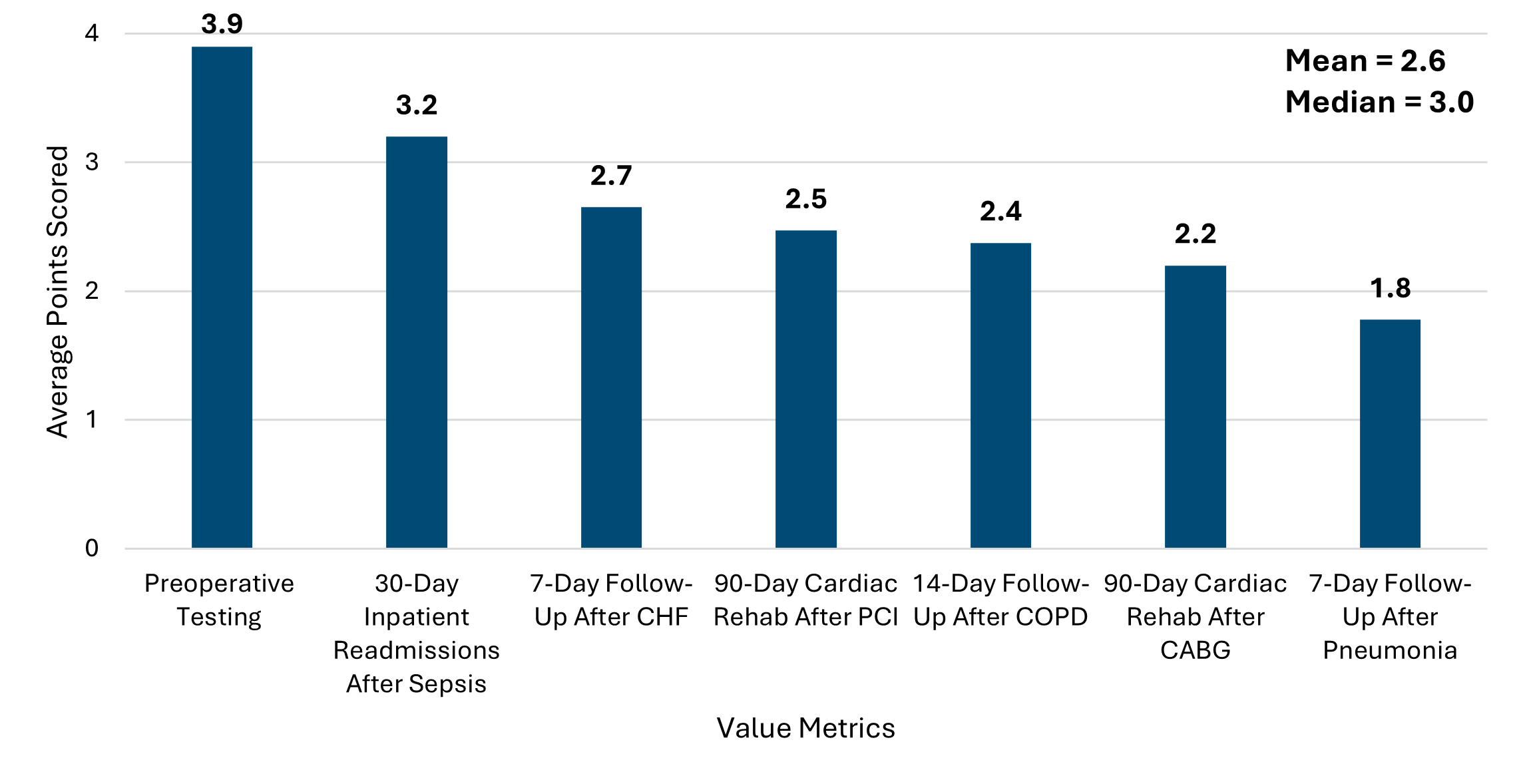
Figure 4 illustrates the breakdown of average points by value metrics. Consistent with PY 2024, the highest scoring value metric was preoperative testing with 3.9 points followed by 30-day inpatient readmissions after sepsis with 3.2 points. The lowest scoring value metric was 7-day follow up after pneumonia and follows the same trend as that of PY 2024 with 1.8 points.

Figure 4.

vertical bar chart of average points by value metrics

This is the second year of a two-year (PY 24-25) P4P cycle. The full methodology for this program cycle can be found in the PY2024-2025 technical document.

In addition to the PY 2025 mid-year scorecard summary, this report also included a preview of the new health outcome variation measure scoring, which will be worth one point in PY 2026-2027 (Figure 5). The table presents the hospital’s payer-specific risk-adjusted readmission rates in the performance year, the baseline and performance indexes for the hospital, and the target indexes required to score a point via improvement or achievement. This table’s scoring is based on PY 2025 data (i.e., 2024 performance year data and 2022 baseline data). Please note that this table was included to help orient members to the scoring methodology for this new measure and does not impact PY 2025 scores. For detailed information about this measure, please refer to this introductory video and PY 2026-2027 P4P technical document.

Figure 5.

Table presents the hospital’s payer-specific risk-adjusted of readmission rates in the performance year, the baseline and performance indexes for the hospital, and the target indexes required to score a point via improvement or achievement.

These PY 2025 P4P mid-year scores are subject to change as new data is added. The final scores will be distributed after all 2024 claims are incorporated into the calculations. Hospitals can track their score via the P4P PY 2024-2025 dashboard reports on the MVC registry, which provides all relevant scoring information for both improvement and achievement points. These registry reports can be filtered by selected conditions/metrics to make tracking of P4P points easier. You can also contact the MVC Coordinating Center [EMAIL] for a walkthrough of your hospital’s PY 2025 mid-year scorecard or P4P registry reports.
Off
View Post
MVC Distributes PY 2024 Final Scorecards for MVC Component of the BCBSM P4P Program

MVC Distributes PY 2024 Final Scorecards for MVC Component of the BCBSM P4P Program

The Michigan Value Collaborative (MVC) Coordinating Center distributed final scorecards for Program Year (PY) 2024 of the MVC Component of the Blue Cross Blue Shield of Michigan (BCBSM) Pay-for-Performance (P4P) Program. This report provided hospitals with their final score for PY 2024 as well as detailed breakdowns by scoring component. This was the first year of a two-year cycle for which MVC claims data was used to score hospitals on their episode spending and value metric selections. PY 2024 used baseline year claims data from 2021 and performance year data from 2023.

The episode spending conditions for which MVC is scoring hospitals for PY 2024 include chronic obstructive pulmonary disease (COPD), colectomy (non-cancer), congestive heart failure (CHF), coronary artery bypass graft (CABG), joint replacement (hip and knee), and pneumonia. These conditions differ slightly from the list of episode spending conditions available in the PY 2026-2027 cycle (view PY 2026-2027 FAQ). Figure 1 shows the frequency of hospital selections for the PY 2024-2025 program cycle for episode spending; the plurality of hospitals selected joint replacement, whereas pneumonia was selected the least.

Figure 1. Frequency of Hospital Selections for PY 2024-2025 Episode Spending

The value metrics for which MVC scored hospitals for PY 2024 included cardiac rehabilitation after CABG, cardiac rehabilitation after percutaneous coronary intervention (PCI), follow-up after CHF, follow-up after COPD, follow-up after pneumonia, preoperative testing, and risk-adjusted readmissions after sepsis. Figure 2 shows that the plurality of hospitals selected 7-day follow up after CHF, and both 90-day cardiac rehab after CABG & 30-day inpatient readmissions after sepsis were selected the least.

Figure 2. Frequency of Hospital Selections for PY 2024-2025 Value Metrics

The MVC Component of the BCBSM P4P Program evaluated each participating hospital’s risk-adjusted, price-standardized, average 30-day episode payments for their selected condition as well as rates of utilization for their selected value metric through two methods. Hospitals earned points via "improvement" by reducing their payment or improving their utilization rate from the baseline period, or alternatively earned "achievement" points by being less expensive or having a better relative utilization rate than the peers in their designated cohort. The MVC cohorts are groups of hospitals determined to be peers using factors such as hospital bed size and case mix index.

While hospitals were scored on both improvement and achievement, members received the higher of those two scores for each of their selections. Hospitals were also eligible to receive engagement points by completing eligible MVC activities. A maximum of 10 points (4 points each for the selected episode spending condition and value metric, 2 points from engagement activities) were awarded to participating members. The distribution of total points earned by hospitals for the PY 2024 is illustrated in Figure 3.

Figure 3. Distribution of Total Points Earned by Hospitals for PY 2024

On average, hospitals earned 6.6 points in total, a decrease of 0.8 points from the PY 2023 average of 7.4 points. Figure 4 shows that the episode spending condition with the highest average awarded points was joint replacement (3.1 points) followed by CABG (2.3 points). Similarly, Figure 5 shows that the value metric with the highest average awarded points was preoperative testing (3.3 points) followed by 90-day cardiac rehabilitation after PCI (2.7 points). The breakdown of average points by each program component is illustrated in Figure 6. On average, hospitals earned 1.7 of the 2 available engagement points.

Figure 4. PY 2024 Episode Spending Average Points Awarded for Each Condition

Figure 5. PY 2024 Value Metrics Average Points Awarded for Each Selection

Figure 6. Average Points Earned for Each Program Component Across Hospitals

If you have any questions regarding PY 2024 of the MVC Component of the BCBSM P4P Program, please refer to the MVC P4P PY 2024-2025 Technical Document. If you would like to set up a meeting to review your hospital’s program year selections or scores, please contact the Coordination Center [EMAIL]. MVC will evaluate and release mid-year scorecards for PY 2025 in the summer of 2025.

Off
View Post
Hospitals Receive PY24 Mid-Year Scorecards for MVC Component of BCBSM P4P Program

Hospitals Receive PY24 Mid-Year Scorecards for MVC Component of BCBSM P4P Program

Last week the Michigan Value Collaborative (MVC) distributed mid-year scorecards for Program Year (PY) 2024 of the MVC Component of the Blue Cross Blue Shield of Michigan (BCBSM) Pay-for-Performance (P4P) Program. This report provided hospitals with their current standing for PY 2024.

Each hospital received a mid-year score out of a total of 10 points, including 0 to 4 points for their selected total episode payment metric, 0 to 4 points for their selected value metric, and 0 to 2 points for completed eligible engagement activities thus far in calendar year 2024. PY 2024 scores achievement and improvement points for each hospital’s selected episode spending conditions and value metrics using index admissions from 2023 as the performance year against admissions in 2021 as the baseline year. Hospitals are awarded the higher of their achievement and improvement point scores.

The performance data timeframes included in mid-year PY 2024 scoring were index events 1/1/2023-12/31/2023 for BCBSM PPO Commercial, BCBSM Medicare Advantage, BCN HMO Commercial, and BCN HMO MA, and index events 1/1/2023-9/30/2023 for Medicare FFS. The engagement points accrued represent all completed activities from 1/1/2024-9/30/2024. This is the first year of a two-year (PY24-25) P4P cycle. The full methodology for this program cycle can be found in the PY2024-2025 technical document.

Figure 1 illustrates the current distribution of total points out of 10 across the collaborative. The average points scored across the mid-year scorecards was 6.2/10. This average is 0.2 points lower than the average points scored at the conclusion of PY23.

Figure 1.

Figure 2 illustrates the breakdown of scoring on average by each program component (i.e., episode spending metric, value metric, engagement points). Hospitals could earn up to four points each for their episode spending and value metric selections, and up to two points for engagement activities. Across the collaborative, the average points scored was higher for value metrics (2.7) than for episode spending (2.5).

Figure 2.

Figure 3 illustrates the breakdown of average points by episode spending condition. Consistent with previous years, joint replacement was the highest scoring condition with an average of 3.1 points. Much of the recent success observed for the joint replacement condition could be attributed to the shift from post-acute care in skilled nursing facilities (SNF) to home health and the move towards outpatient surgeries; however, with most joint replacements now occurring in outpatient settings there is less savings to be achieved from such shifts going forward. Congestive heart failure and pneumonia were the lowest scoring conditions with hospitals earning less than two points on average for each.

Figure 3.

Figure 4 illustrates the breakdown of average points by value metric. The highest scoring value metric was preoperative testing with 3.4 points followed by 90-day cardiac rehab utilization after percutaneous coronary intervention (PCI) with 2.8 points. For both of these value metrics, hospitals have access to additional support and resources via MVC’s value-based improvement initiatives, including the RITE-Size (Right-Sizing Testing before Elective Surgery) initiative and the Michigan Cardiac Rehab Network (MiCR) offerings. The lowest scoring value metric was 7-day follow-up rates after pneumonia (2.1).

Figure 4.

These mid-year P4P scores are subject to change as new data is added. The final scorecards will be distributed after all 2023 claims are incorporated. Hospitals can track their score through the P4P PY24-25 reports on the MVC registry, which provides all relevant scoring information for both improvement and achievement points in one place. These registry reports can be filtered by selected conditions/metrics to make the tracking of P4P points easier. Contact the MVC Coordinating Center [EMAIL] for a walkthrough of your hospital’s PY24 mid-year scorecard or P4P registry reports.
Off
View Post
MVC Finalizes Summary Evaluation of PY22-23 P4P Cycle

MVC Finalizes Summary Evaluation of PY22-23 P4P Cycle

This year, the Michigan Value Collaborative (MVC) completed all scoring and evaluation for Program Year 2023 of the MVC Component of the Blue Cross Blue Shield of Michigan (BCBSM) Pay-for-Performance (P4P) Program. This concluded a two-year program cycle encompassing the program methodologies and conditions utilized in PYs 2022 and 2023. MVC is excited to share its member evaluation document for these two program years, which highlights hospital performance on average 30-day risk-adjusted, price-standardized total episode payments for the included conditions across both program years.

The PY 2022-2023 program cycle utilized episode claims from 2019 through 2022. PY 2022 scoring compared performance year data from 2021 against baseline year data from 2019. PY 2023 scoring compared performance year data from 2022 against baseline year data from 2020.

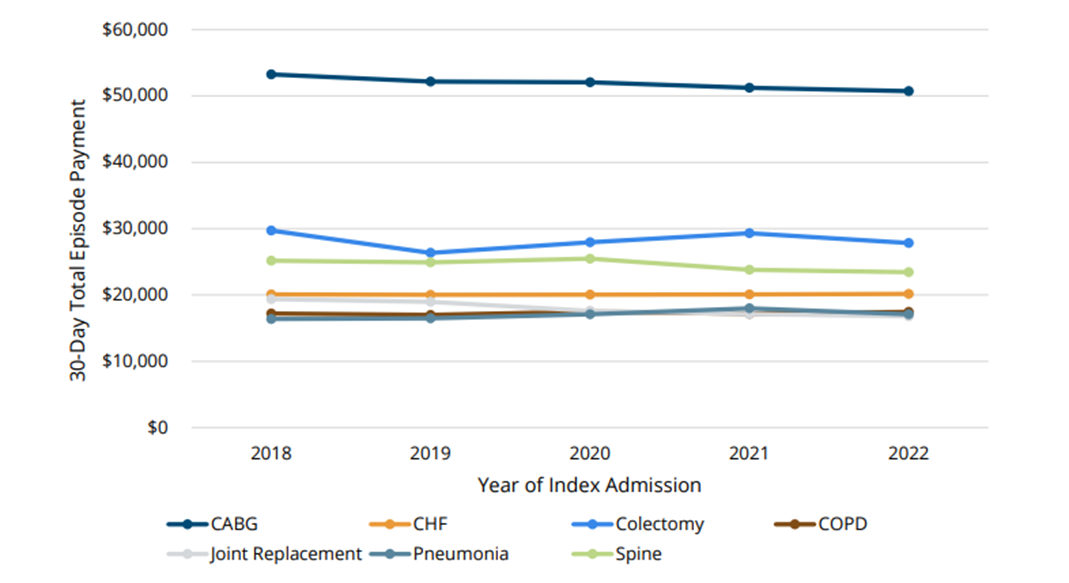
Hospitals chose two conditions from seven available options for the PY 2022-2023 program cycle, including chronic obstructive pulmonary disease (COPD), coronary artery bypass graft (CABG), congestive heart failure (CHF), colectomy (non-cancer), joint replacement (hip and knee), spine surgery, and pneumonia. Among these seven P4P conditions, joint replacement was the most selected condition (40), and colectomy was selected the least (4). Trends in average price-standardized episode payments showed a consistent decrease over the years for CABG and joint replacement, and a recent downward trend for pneumonia, spine, and colectomy payments as seen in Figure 1. MVC observed relatively consistent average payments over time for CHF and COPD episodes during PY 2022-2023.

Figure 1. Average Price-Standardized Episode Payment Trends for P4P Conditions

The most striking observation in PYs 2022 and 2023 is the increasing shift to the outpatient setting for both spine and joint replacement surgeries. For joint replacement surgeries, 23.2% of episodes took place outpatient in 2019, 49.4% were outpatient in 2020, 71.6% were outpatient in 2021, and 85.4% were outpatient in 2022. Similar shifts were observed for spine surgeries during the PY 2022-2023 cycle, with the percent of outpatient spine surgery procedures increasing from 30.4% in 2019 to 51.4% in 2022 as seen in Figure 2.

Figure 2. Utilization of Outpatient Setting for Spine Surgery by Year

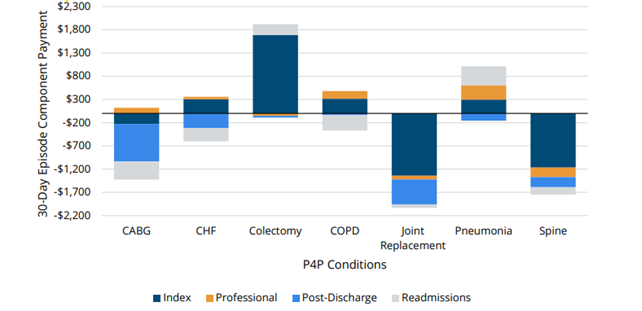
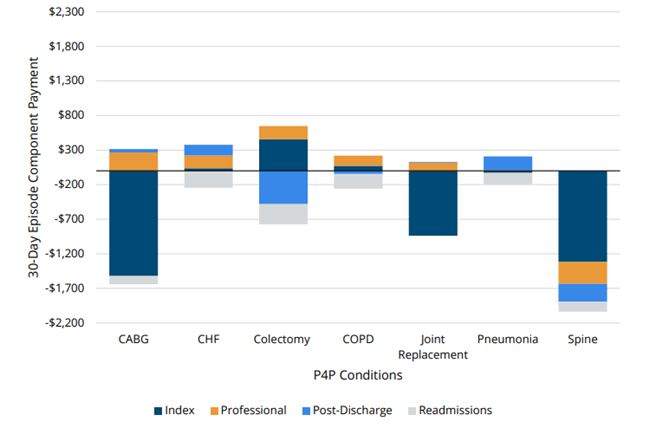
This shift in outpatient utilization also impacted the decrease in average total episode payments since the associated costs for outpatient surgeries were significantly lower than inpatient surgeries. The decrease in total episode payments for spine and joint replacement surgeries was largely reflected in the index payments for PYs 2022 and 2023 respectively (Figures 3 and 4).

Figure 3. Change in Average Price-Standardized Episode Components, PY 2022

Figure 4. Change in Average Price-Standardized Episode Components, PY 2023

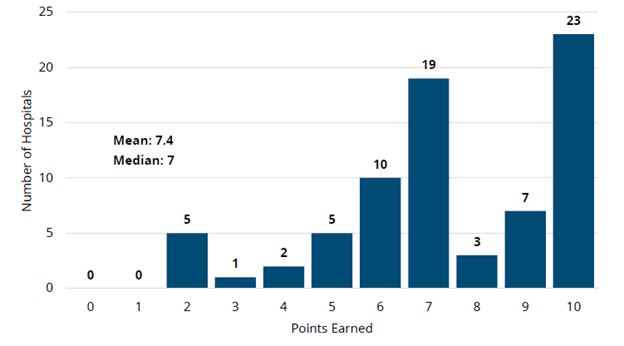
Overall, there was not much change between PY 2022 and PY 2023 in the overall points earned and average points based on hospital characteristics, though the scores on average were slightly higher in PY 2022 (Figures 5 and 6).  For detailed, condition-specific analyses on scoring, please refer to the full member evaluation document.

Figure 5. PY 2022 Total Point Distribution (Includes Bonus Points)

Figure 6. PY 2023 Total Point Distribution (Includes Bonus Points)

If you have any questions regarding the MVC Component of the BCBSM P4P Program, please reference the P4P Technical Document for Program Years 2022 and 2023 and the MVC P4P FAQ PY 2022-2023. If you would like to set up a meeting to review your hospital’s performance, please contact the Coordinating Center at Michigan-Value-Collaborative@med.umich.edu.


Off
View Post
Hospitals Receive PY23 Mid-Year Scorecards for MVC Component of BCBSM P4P Program

Hospitals Receive PY23 Mid-Year Scorecards for MVC Component of BCBSM P4P Program

This week the Michigan Value Collaborative (MVC) distributed mid-year scorecards for Program Year (PY) 2023 of the MVC Component of the Blue Cross Blue Shield of Michigan (BCBSM) Pay-for-Performance (P4P) Program. PY2023 scores achievement and improvement points for each hospital’s selected episode spending conditions using index admissions from 2022 as the performance year against admissions in 2020 as the baseline year. Hospitals can earn up to five points for each condition using the higher of a hospital's achievement and improvement point scores. This is the second year of a two-year (PY22-23) P4P cycle.

This cycle also offers hospitals bonus points for completing and submitting a survey for each selected condition by November 15, 2022. These surveys will be used by the MVC Coordinating Center to improve the program for future years and support practice sharing between members. The full methodology for this program cycle can be found in the PY2022-2023 Technical Document.

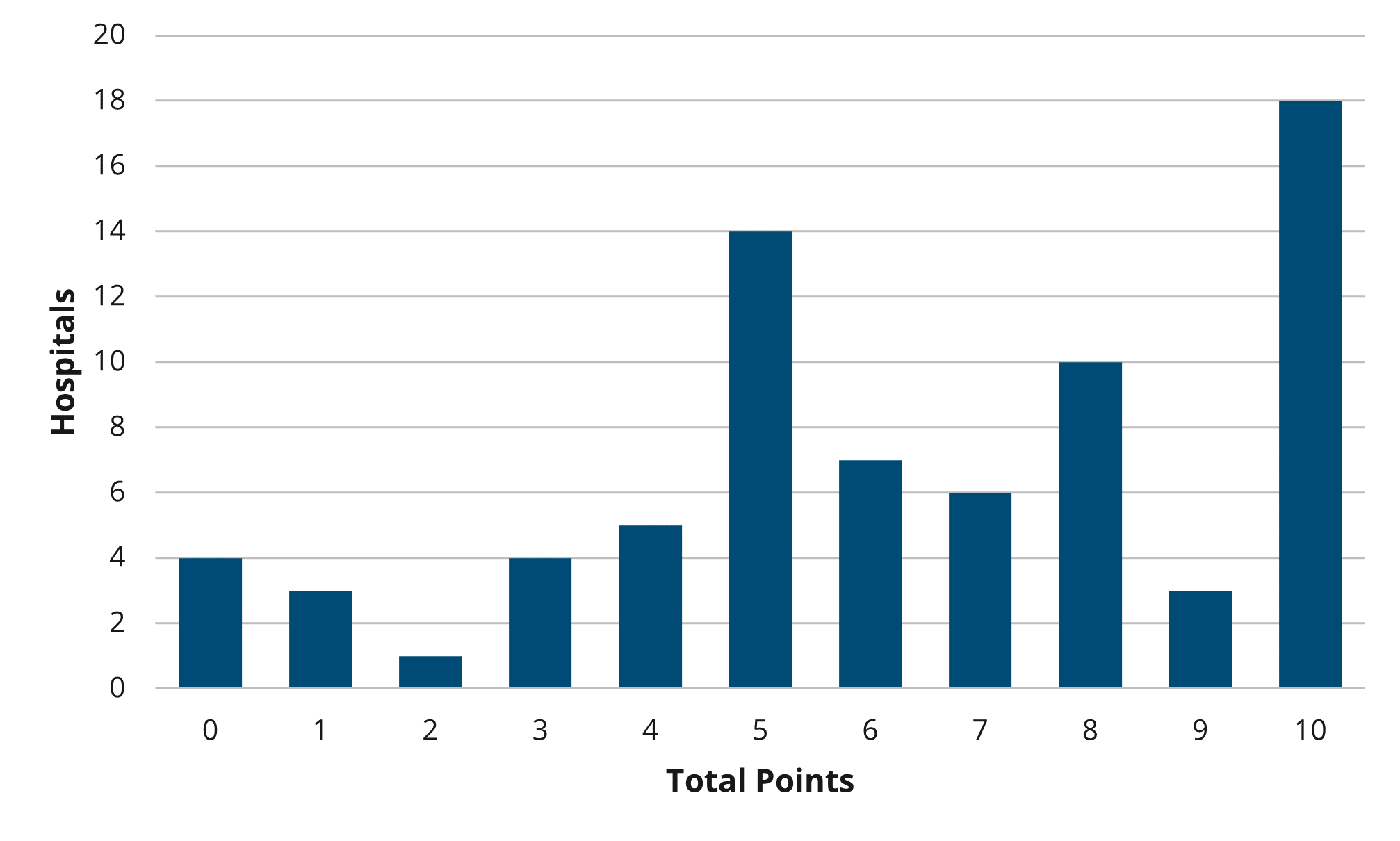
Figure 1 below illustrates the current distribution of total hospital points out of 10. The average points scored across the mid-year scorecards was 6.4/10 before including the survey bonus points. This is 0.4 points higher than the average points scored at the conclusion of PY22 excluding all bonus points.

Figure 1.

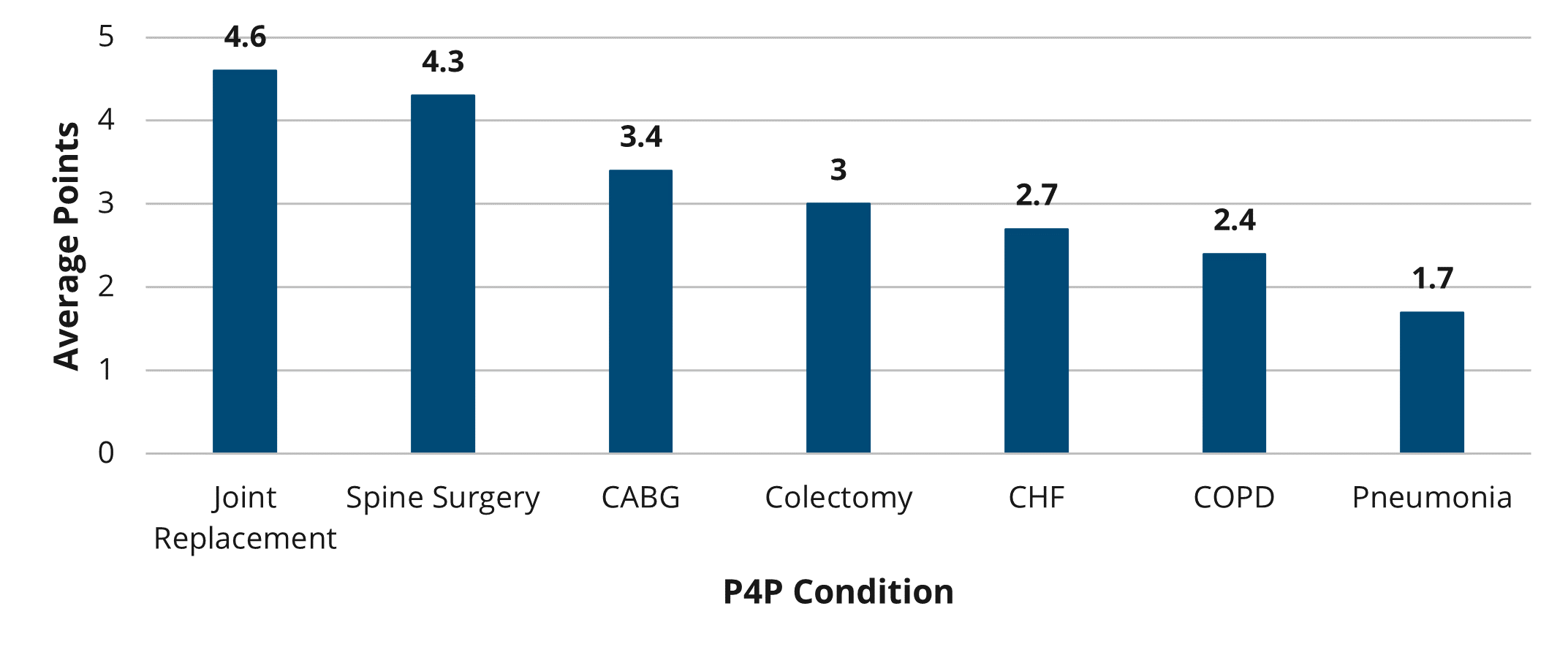
Figure 2 below illustrates the breakdown of average points by condition. Hospitals could earn up to five points for each condition. Consistent with previous years, joint replacement was the highest scoring condition with an average of 4.6 points. Much of the success observed for the joint replacement condition can be attributed to the shift from post-acute care in skilled nursing facilities (SNF) to home health and the move towards outpatient surgeries. Pneumonia was the lowest scoring condition with hospitals earning less than two points on average.

Figure 2.

These mid-year P4P scores are subject to change as new data is added. The final scorecards will be distributed after all 2022 claims are incorporated. Hospitals can track their score through the P4P PY22-23 reports on the MVC registry, which provides all relevant scoring information for both improvement and achievement points in one place (bonus points are not reflected on the registry). These registry reports can be filtered by selected conditions to make the tracking of P4P points easier. Contact the MVC Coordinating Center for a walkthrough of your hospital’s PY23 mid-year scorecard or P4P registry reports.
Off
View Post
Hospitals Receive PY22 Mid-Year Scorecards for MVC Component of BCBSM P4P Program

Hospitals Receive PY22 Mid-Year Scorecards for MVC Component of BCBSM P4P Program

This week the Michigan Value Collaborative (MVC) Coordinating Center distributed the Mid-Year Scorecards for Program Year (PY) 2022 of the MVC Component of the Blue Cross Blue Shield of Michigan (BCBSM) Pay-for-Performance (P4P) Program. These were the first scorecards for the new two-year program cycle for PYs 2022 and 2023.

PY2022 evaluates the index admissions from 2021 as the performance year against admissions in 2019 as the baseline year. MVC is using an improved z-score methodology to calculate both improvement and achievement scores. Hospitals will continue to receive the better of the two scores for each of their two selected conditions. For a description of how the program has changed from the last two-year cycle see the Change Document.

Additionally, this cycle offers hospitals bonus points for completing and submitting a survey for each selected condition by November 1, 2022. These surveys will be used by the MVC Coordinating Center to improve the program for future years and elicit improved best practice sharing between members. The full methodology for the new program can be found in the PY2022-2023 Technical Document.

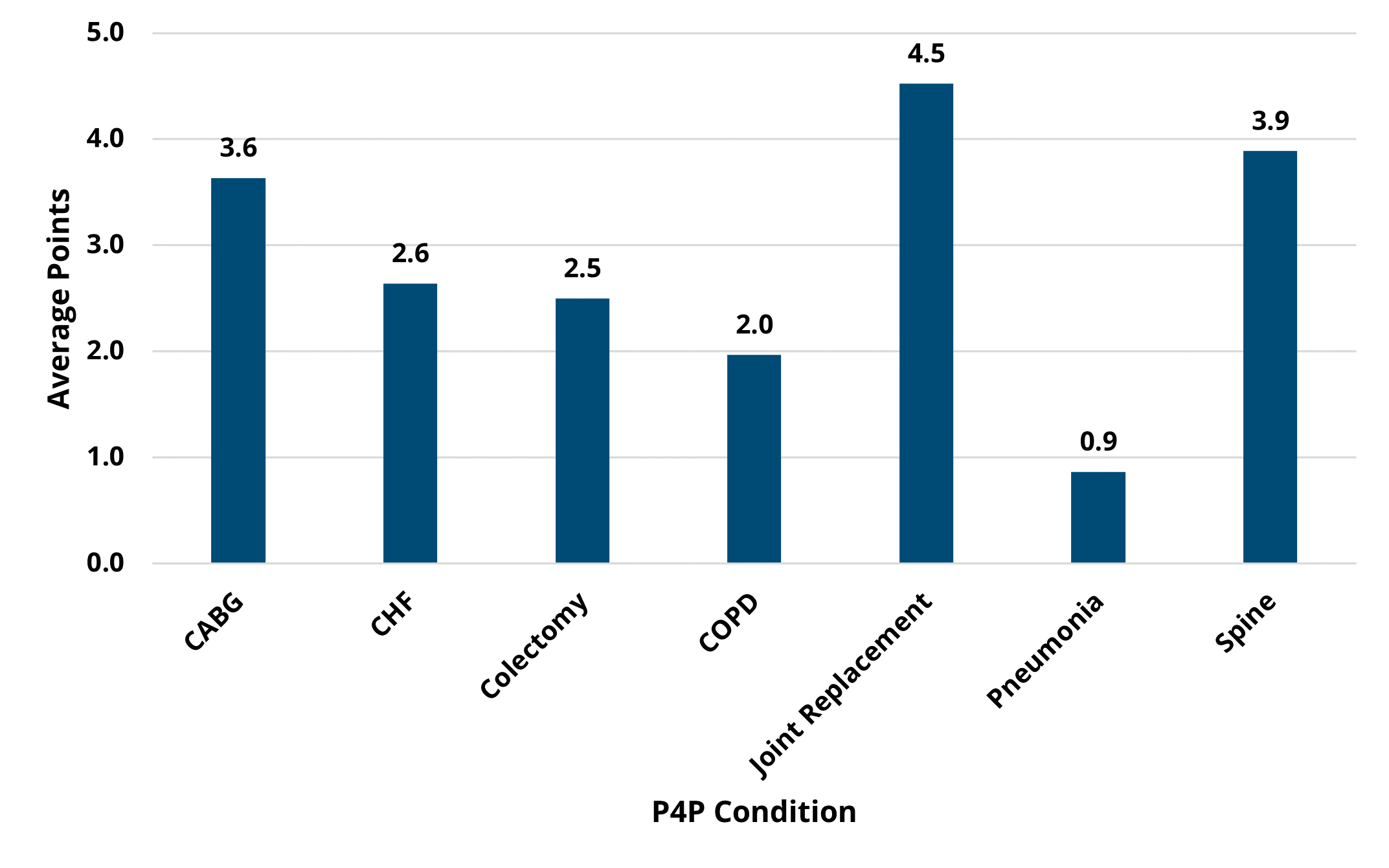
Figure 1 below illustrates the distribution of total hospital points out of 10. The average points scored for the Mid-Year Scorecards was 5.9/10 before including the survey bonus points. This is 0.9 points higher than the average points scored at the conclusion of PY21 excluding all bonus points.

Figure 1.

Figure 2 below illustrates the breakdown of average points by condition out of five. Consistent with previous years, joint replacement was the highest scoring condition with an average of 4.5 points earned. The success of the joint replacement condition can be attributed to the shift from post-acute care in skilled nursing facilities (SNF) to home health and the move towards outpatient surgeries. Pneumonia was the lowest scoring condition with hospitals earning less than one point on average. The MVC average payment for a 30-day pneumonia episode increased by $792 from the baseline in 2019 to the performance year in 2021. The largest contributors to this increase were the base payment and readmission payments.

Figure 2.

The Mid-Year P4P scores are subject to change as new data is added. The final scorecards will be distributed after all 2021 claims have been added to the data in quarter one of 2023. Hospitals can track their score through the new P4P PY2022-2023 reports on the MVC registry. These new reports provide all relevant scoring information for both improvement and achievement points in one place except for the survey bonus points. They can be filtered by selected conditions to make the tracking of P4P points easier. For a walkthrough of your hospital’s Mid-Year P4P Scorecard or P4P registry reports, please contact the MVC Coordinating Center.