1
View Post
New MI Mind CQI Connects Body and Mind to Health in Michigan

New MI Mind CQI Connects Body and Mind to Health in Michigan

Suicide is a leading cause of death in the United States. It claimed nearly 46,000 lives in 2020—a rate 30% higher than two decades ago. More recent data has even shown an increase in the rate of suicide after two years of declining rates. In the state of Michigan, the suicide mortality rate was 14 per 100,000 people.

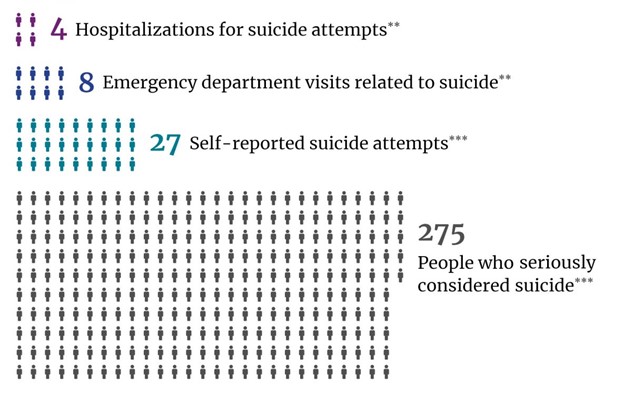
There are significant opportunities for suicide prevention in primary care and other healthcare settings. Research suggests that patients seek care from primary care physicians within 30 days of establishing a suicide plan or attempting suicide. Furthermore, for every suicide death, there are four hospitalizations and eight emergency department visits (Figure 1).

Figure 1.
In response to this significant health need in Michigan, Blue Cross Blue Shield of Michigan partnered with Henry Ford Health to launch a new Collaborative Quality Initiative (CQI) called the Michigan Mental Innovation Network and Program Design (MI Mind). The MI Mind Coordinating Center team brings providers, health systems, and suicide prevention experts together to reach shared goals of improving suicide prevention, care, and access to key behavioral health services in Michigan. Its mission is to engage psychiatrists, psychologists, and primary care physicians in the use of care pathways to reduce suicides in Michigan significantly.

The core program is a collaboration with provider organizations that aims to determine and implement system-specific suicide prevention elements and use data to implement rapid cycle quality improvement processes. MI Mind hopes to assess what levels and characterizations of risk are most urgent and can be addressed by clinicians to inform recommendations for suicide prevention and quality improvement. The MI Mind program will help facilitate enhanced collaboration and referrals among behavioral health and primary care clinicians and promote purposeful screening for suicidal risk. The MI Mind team aims to train clinical staff using the well-established Zero Suicide protocol and anticipates the program will improve patient support, enable more effective and efficient healthcare, and reduce suicide rates.

The MI Mind collaborative is co-led by Program Director Brian Ahmedani, PhD, LCSW, who is internationally recognized for his work in suicide prevention and the Director for the Center for Health Policy and Health Services Research at Henry Ford Health; and Program Director Cathrine Frank, MD, a practicing and board certified psychiatrist widely regarded as the original clinical architect of the Zero Suicide program and Chair of the Department of Psychiatry and Behavioral Health Services at Henry Ford Health.

For more information on MI Mind, visit their website, where a variety of easy-to-use, organized tools and materials or available for the benefit of primary care providers, behavioral health professionals, patients, and their loved ones. Providers may also contact the MI Mind Coordinating Center at MiMIND@hfhs.org. In addition, the 988 Suicide and Crisis Lifeline (previously the Suicide Prevention Lifeline) is available to provide equitable and accessible suicide prevention support across the United States.

As the Michigan Value Collaborative (MVC) continues to build its offerings for members, the Coordinating Center is mindful that many other CQIs also partner with hospitals and providers throughout Michigan. MVC posts recurring feature blogs about some of its peer CQIs to showcase their activities and highlight collaborations with MVC. Please reach out to the MVC Coordinating Center with any suggestions or questions.
4
View Post
HBOM Resources Help CQIs, Providers Reduce Smoking

HBOM Resources Help CQIs, Providers Reduce Smoking

Today, the leading preventable cause of death, disease, and disability in the United States is tobacco use. National studies show that 70% of smokers want to quit, but in Michigan only about 15% receive treatment. This critical gap is the current focus of one of the newest population health Collaborative Quality Initiatives (CQIs) in the Blue Cross Blue Shield of Michigan (BCBSM) Value Partnerships portfolio. The Healthy Behavior Optimization for Michigan (HBOM) CQI aims to ensure that all smokers who are interested in quitting receive the support and resources they need to be successful.

HBOM’s mission is to make “the healthy choice the easy choice,” which is accomplished in this case by providing tobacco cessation support throughout the state of Michigan through value-based reimbursement (VBR). In 2022, nine CQIs committed to working with HBOM to provide targeted, just-in-time tobacco cessation support to seize on their “teachable moment.” This approach draws on evidence-based behavior change strategies that leverage unique shifts in patient motivation around major health events, when they may find new motivation to commit to positive health behaviors like smoking cessation.

HBOM works with hospitals, clinics, and care teams across the state of Michigan through its partner CQIs to promote healthy behaviors among patients. They also provide partner CQIs and their respective members with the infrastructure and metrics to measure the impact of these changes. Although HBOM is primarily concerned with three health behaviors (smoking cessation, healthy eating, and physical activity), smoking cessation is their current focal point.

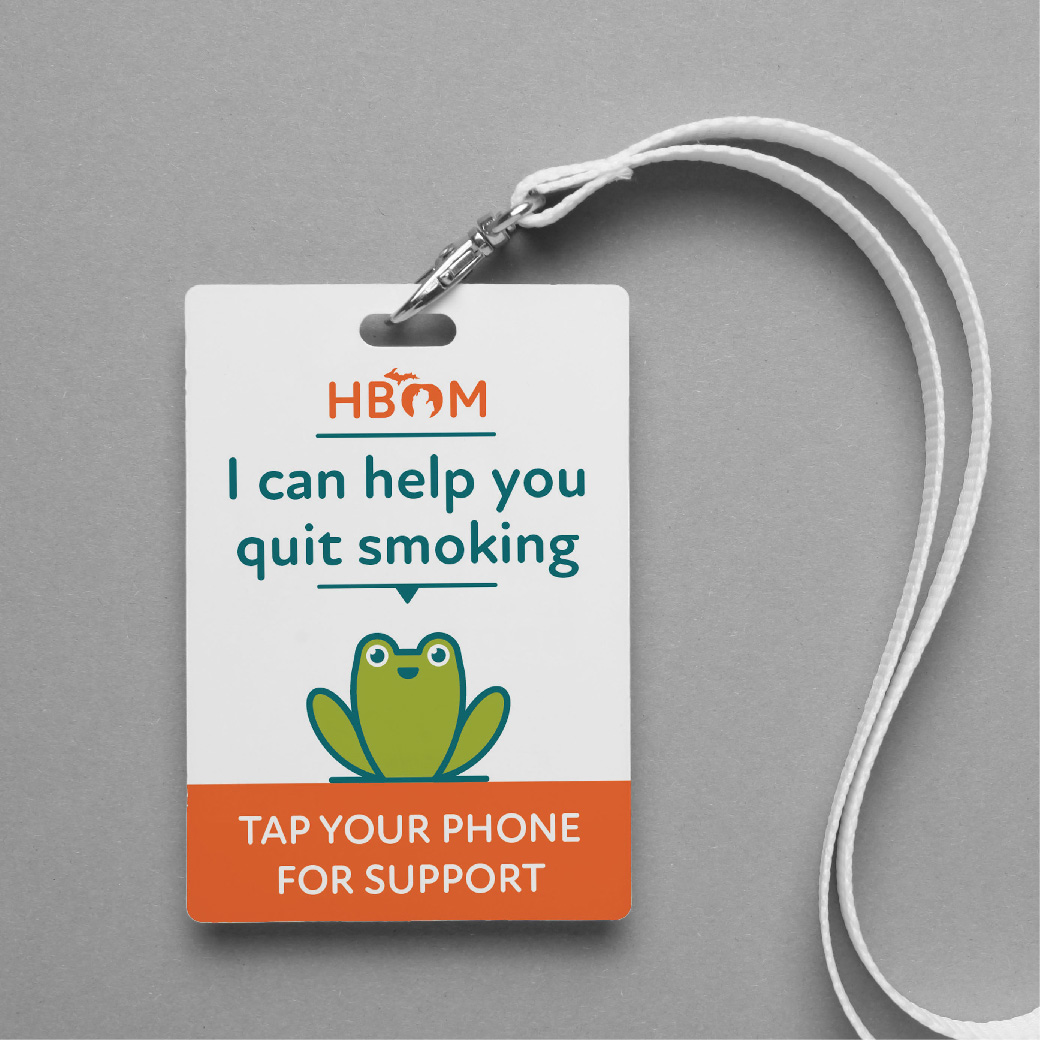
HBOM’s smoking cessation tools and resources are available in both paper and electronic formats to ensure equitable access, and are being shared widely at the patient, physician, and organization levels. Clinicians can share these materials with patients to increase access, awareness, and utilization of smoking cessation opportunities. One example includes a “Tap for Support” near-field communication (NFC) badge (see Figure 1) that clinicians and healthcare staff can wear for patients to scan with their phone, providing them with instantaneous online smoking cessation tools and resources.

Figure 1.

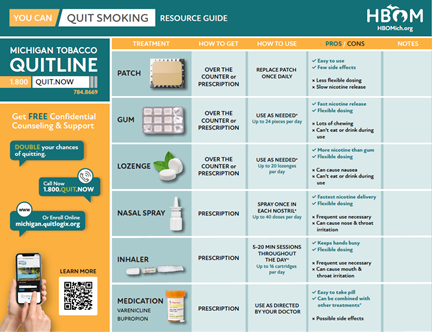
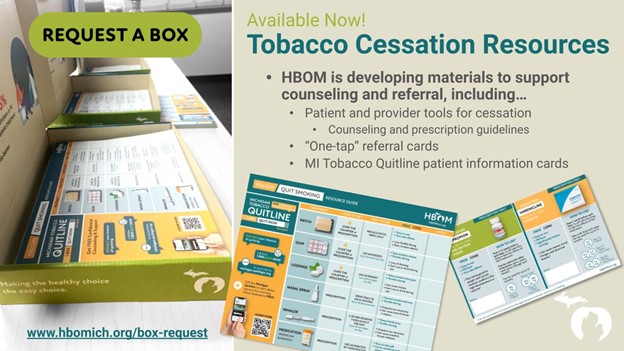
Another example is the Tobacco Cessation Box that HBOM tailored to meet the needs of those wishing to quit smoking. In addition to the badges, it includes HBOM’s Quit Smoking Resource Guide Tear Off Pad (see Figure 2), which providers can use as a discussion tool for Nicotine Replacement Therapy options. The box also includes a reference guide containing a high-level overview of tobacco cessation prescription medication options and HBOM’s VBR toolkit.

Figure 2.

When CQIs and their members wish to learn more or provide support beyond the resources mentioned above, they can connect with HBOM to discuss state-wide smoking cessation metrics, best practices, challenges, and collaboration opportunities. The HBOM collaborative meets regularly with participants and partnering CQIs to address challenges and improve population health. The team is also closely connected with the Michigan Tobacco Quitline and resource recommendations delivered by text message for anyone who wishes to quit smoking.

The MVC and HBOM teams have discussed plans to include HBOM resources in future relevant MVC report communications, such as those chronic conditions that are related to tobacco use. In the meantime, hospitals and physicians can request their own tobacco cessation boxes (see Figure 3).

Figure 3.

For more information on HBOM, visit their website.

As the Michigan Value Collaborative (MVC) continues to build its offerings for members, the Coordinating Center is cognizant that many other CQIs also partner with hospitals and providers throughout Michigan. Throughout 2022, MVC will post a series of blogs about some of its peer CQIs to showcase their activities and highlight collaborations with MVC. Please reach out to the MVC Coordinating Center with any suggestions or questions.
1
View Post
New Collaborative MIBAC Seeks to Address Back Pain

New Collaborative MIBAC Seeks to Address Back Pain

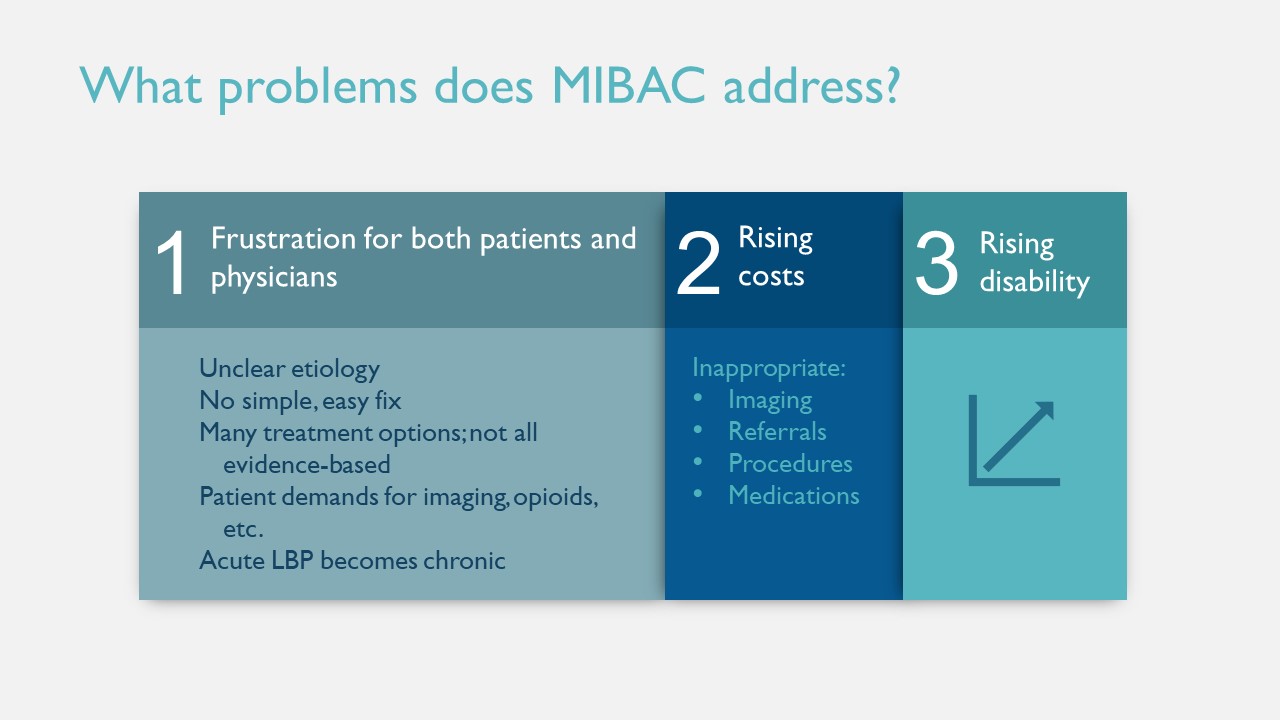
Lower back pain is a common—and challenging—realm of healthcare that is the leading cause of disability globally. As many as 80-95% of patients presenting to primary care providers with this condition have no identifiable origin for their pain. The absence of a specific etiology is exacerbated by challenges related to treatment; although there are many treatment options, not all are evidence-based and there is rarely a simple, easy fix. In addition, most primary care physicians do not like managing back pain and feel they have not been adequately trained in musculoskeletal medicine.

With the above considerations in mind, researchers argue that greater attention is urgently needed in response to the rising burden and impact of this condition. Low back pain was, therefore, an ideal area of focus for the Blue Cross Blue Shield of Michigan’s Collaborative Quality Initiatives (CQI) portfolio. The Michigan Back Collaborative (MIBAC) was rolled out in 2021 and is based at Henry Ford Hospital. This new statewide quality improvement initiative focuses on better care for low back pain to address issues such as rising costs, rising disability, and patient and provider dissatisfaction (see Figure 1).

Figure 1

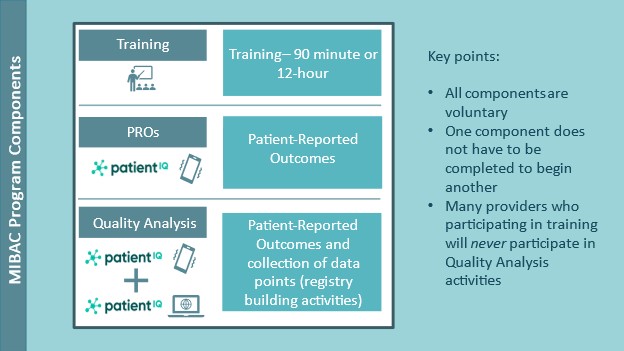
MVC Coordinating Center staff had the pleasure of meeting with the MIBAC team recently to learn more about the program, its focus, and goals. MIBAC has two components: training and quality analysis (see Figure 2). Training is the focus of the first year of commitment to the collaborative, with progression to quality analysis in years two or three. These components are all voluntary and participation in one is not contingent on completion of another.

Figure 2

MIBAC membership currently includes clinicians such as primary care physicians and chiropractors, as these are typically the “first-contact” clinicians for low back pain. As the program expands, there is a plan for additional provider types (including physical therapists and emergency room physicians) to become involved as members of the collaborative, and the MIBAC Coordinating Center is working to recruit more physician organizations as well as independent chiropractic practitioners from across the state of Michigan.

MIBAC’s evidenced-based training is available to all its providers and was delivered to more than 800 primary care and chiropractic practitioners in 2021. The curriculum was developed by Spine Care Partners and delivers information on a biopsychosocial model of spine care management. Education is provided on guidelines for referrals, imaging, and pain medication, with an emphasis on solutions and techniques that cultivate inter-professional and doctor-client partnerships. Training sessions are offered virtually and in-person and provide continuing educational credit.

MIBAC is also planning to provide data for clinicians to support more effective care patterns, better outcomes for patients, and greater satisfaction for clinicians and patients. The MIBAC database will integrate patient-reported outcomes (PROs) along with clinical and demographic data. The hope and goal of the MIBAC registry is to identify variations in practice and key quality metrics whilst building clinical and administrative “best-practices” in spine care. In order to establish a data cohort, MIBAC will focus on a six-month review and a six-month follow-up as their defining period. MIBAC plans to cultivate collaboration and networking between participating members at meetings, site visits, webinars, and other strategies.

To date, the MVC team has supported the MIBAC Coordinating Center to assess the utilization of appropriate imaging by providers to inform the development of the collaborative's VBR program. Moving forward, the MVC team will continue to work closely with MIBAC to explore other avenues to help achieve the collaborative's aim of achieving better care for low back pain for Michigan residents.

For more information on MIBAC, visit their website at https://mibac.org/.

As the Michigan Value Collaborative (MVC) continues to build its offerings for members, the Coordinating Center is cognizant that many other CQIs also partner with hospitals and providers throughout Michigan. Throughout 2022, MVC will post a series of blogs about some of its peer CQIs to showcase their activities and highlight collaborations with MVC. Please reach out to the MVC Coordinating Center with any suggestions or questions.
Off
View Post
Henry Ford Health System – Cardiac Rehab

Henry Ford Health System – Cardiac Rehab

At the most recent congestive heart failure MVC workgroup, Dr. Steven Keteyian, Section Head of the Cardiac Rehabilitation/Preventive Cardiology Unit at Henry Ford Medical Group, presented on exercise-based cardiac rehabilitation in patients with heart failure. Dr. Keteyian started out by discussing the importance of cardiac rehabilitation and adhering to a program in order to improve exercise tolerance and disease-specific outcomes. Exercise intolerance is measured and the information gathered can be used to stratify a patient’s future risk. If the measurement improves over time, Dr. Keteyian discussed the potential for a decrease in risk of death and re-hospitalization. This shows a tie to directly improving outcomes and symptoms in cardiac rehabilitation. Also, in the words of Dr. Keteyian, “functionally, the more they don’t do, the less they can do.”

Cardiac rehab is a Class I recommendation from The American College of Cardiology for all of the traditional cardiac disorders. Henry Ford has a 36-visit program that is anchored on exercise training. Between four and fifteen people are in each class and each person receives an individual treatment plan with a focus on bio-behavioral components. Six core components make up the program which include outcome assessments, supervised exercise, dietary/weight management, tobacco abuse, psychological support, and medication adherence. All participants participate in 30-minute behavioral education sessions which cover topics such as nutrition, dining out, proper exercise, medication compliance, and other relevant disease-management self-care activities. These same topics are also available on YouTube and can be found here, all of which are available for use in your cardiac rehab program. Currently, Henry Ford is working on bringing their time to enrollment after hospital discharge to less than 21 days and increasing adherence to the 36-visit program. The goal is to achieve a participation rate of 70% or more in cardiac rehab for Henry Ford’s patient population.

After discussing the program specifics at Henry Ford, Dr. Keteyian discussed the barriers that one may face in relation to participation in cardiac rehab. These barriers include:

  • Demographic
  • Difficulty contacting patient after hospitalization
  • Return to work demands
  • Transportation
  • Co-payment obligations
  • Dependent care responsibilities

Henry Ford is working at a system level in order to increase the percent of patients who gain access to cardiac rehab. This includes increasing the use of electronic medical record (EMR) driven automatic referrals, with an option for users to opt-out if necessary. Additionally, a member of the cardiac rehab team goes to the inpatient setting and talks to patients to establish a touchpoint before they leave the hospital. This five-minute conversation is all some patients need in order to see the importance and benefits of rehab. Lastly, Henry Ford is working to shorten the discharge to start time. Each day after discharge, the chance of getting patients started in rehab decreases by 1% for each day that passes. Henry Ford is working diligently in order to help decrease this risk.

In 2016, Henry Ford launched a hybrid home-based cardiac rehabilitation service. This includes some visits at the clinic and other virtual sessions. Previously being tied to a single visit at a time on their current streaming platform, Henry Ford will roll out a WebEx model in February 2021 that will allow up to six cardiac rehab appointments to occur at one time. This will provide more of a group setting. Currently, a randomized controlled trial is being done on center based cardiac rehab versus hybrid cardiac rehab. Improvements in fitness and the number of sessions attended are being assessed.

If you are interested in watching the entire workgroup, please click here.  If interested in any information about this workgroup, or other MVC workgroups please email michiganvaluecollaborative@gmail.com