
Off
View Post
Highlights from MVC’s Third Quarter Newsletter

Highlights from MVC’s Third Quarter Newsletter

The Michigan Value Collaborative (MVC) had a busy third quarter of 2026, with new data and reporting resources, expanded value-based improvement efforts, and continued opportunities to connect with members across Michigan. MVC's latest quarterly newsletter, distributed at the end of October, brings together these updates and more. For those who missed the newsletter or aren't yet subscribed to the MVC mailing list, here are a few highlights from the July-September 2026 issue:

One of the quarter's key highlights was its collaborative-wide meeting on Oct. 9 in Livonia, bringing together 87 attendees representing 55 hospitals, 13 multi-hospital systems, and five physician organizations. Under the theme Unlocking Data for QI Impact: Translating Insights into Action, the meeting explored how organizations can use MVC data to identify opportunities, inform improvement strategies, and translate performance insights into meaningful action. The newsletter includes a link to the meeting recap.

Another significant update this quarter was the introduction of MVC's new Systems Value-Based Initiative (VBI). Building on MVC's established hospital-level improvement framework, the new initiative extends value-based improvement efforts across entire healthcare systems. By examining performance across system members, MVC aims to help identify variation, share successful practices, and support quality improvement at a broader scale.

MVC also shared several important updates related to the MVC Component of the Blue Cross Blue Shield of Michigan (BCBSM) Pay-for-Performance (P4P) Program. The newsletter highlights that hospitals received their PY2026 mid-year scorecards, marking the first year of the new two-year P4P cycle (PY2026–2027). In addition, MVC published its fifth annual Qualified Entity Certification Program (QECP) public report, which presents aggregated, unidentified data on Michigan hospital performance related to 30-day rehospitalizations following the start of home health care and outpatient follow-up after hospitalization for congestive heart failure or chronic obstructive pulmonary disease. MVC also hosted P4P webinars to discuss the health outcome variation measure and introduce new registry reports for the PY26/27 cycle.

New data and reporting resources were another focus of the quarter. In September, MVC's registry was updated with new payer data, along with the new P4P registry reports. MVC also distributed push reports focused on cardiac rehabilitation and common conditions in September and October, respectively, providing members with additional opportunities to review performance and identify areas for quality improvement.

Beyond data and reporting, MVC continued to bring members together through clinical workgroups, educational programming, and networking opportunities. Quarterly workgroup sessions covered a range of clinical and quality improvement topics, with presentation recaps and materials available through MVC's monthly workgroup blogs. In October, MVC also hosted a networking dinner ahead of its collaborative-wide meeting, giving members an opportunity to build connections and exchange ideas outside of the formal meeting program.

Looking ahead, MVC is seeking member presenters for 2027 events. Hospitals interested in sharing their quality improvement experiences and lessons learned can submit presentation proposals on a rolling basis, with accepted presentations eligible for 0.5 P4P engagement points toward PY27. The newsletter also includes information about upcoming workgroups, site coordinator education modules, and site visits in 2027.

These highlights offer just a glimpse of MVC's recent work and ongoing collaboration with members. Read the full Q3 2026 newsletter for additional updates, resources, upcoming events, and ways to get involved.

Not currently receiving MVC's quarterly newsletter? Subscribe to the MVC mailing list to stay up to date on new resources, program announcements, member activities, and opportunities to engage with the MVC community.
Off
View Post
Introducing MVC Systems VBI: Measuring Value Across Healthcare Systems

Introducing MVC Systems VBI: Measuring Value Across Healthcare Systems

MVC's Value-Based Initiatives (VBIs), formerly known as Value Coalition Campaigns, are designed to focus collaborative improvement efforts around a specific value-based care opportunity in Michigan. These initiatives bring together MVC's suite of offerings around a defined area where coordinated action can help reduce unwarranted variation, improve outcomes, and increase value for patients and providers. Applications of this framework to date focused on reducing inpatient post-acute care after joint replacement, improving cardiac rehabilitation utilization, and improving appropriateness of preoperative testing before low-risk surgery.

MVC now plans to pursue a new, additional VBI encompassing more aspects of healthcare quality that focuses on measuring system performance. VBIs historically intended to translate data into actionable opportunities for improvement at the hospital level — helping MVC members understand where variation exists, learn from one another, and identify strategies that can be applied across organizations and care settings. MVC’s new systems VBI represents an evolution of this approach: applying the same value-based improvement framework to opportunities that extend beyond individual hospitals and span entire healthcare systems.

Why Focus on Healthcare Systems?

Healthcare in Michigan increasingly happens across systems rather than within a single hospital. Today, 89% of MVC's hospital members belong to a larger healthcare system. This creates an important opportunity for value-based improvement, because many of the factors that influence quality and outcomes at an individual hospital extend beyond its walls. Therefore, MVC has identified the opportunity to use its claims data and engagement opportunities to help drive quality improvement not just at the hospital level, but within and across the systems they belong to.

Building on Existing Momentum

The systems VBI builds on several years of MVC's work to help members understand performance beyond the individual hospital. MVC has gradually expanded its ability to provide system-level data, engagement, and benchmarking, creating a foundation for more formal system-level improvement efforts:

  • MVC has offered registry access tailored to system-level quality leads for several years
  • Since 2020, MVC produced system-level push reports on a range of topics.
  • In 2024, MVC added system-level site visits to the engagement menu for the MVC Component of the BCBSM P4P program.
  • Starting in 2026, site coordinators for individual hospitals can benchmark key performance metrics across their system on MVC's registry.
  • MVC’s 2026 spring collaborative-wide meeting and June networking event featured system-level themes.

Together, these efforts have created a foundation for MVC to move from providing system-level insight to actively focusing collaborative improvement efforts at the system level through a formal VBI.

A Vision for System-Level Value Improvement

The systems VBI work has initially been focused on measurement as a starting point for focused improvement — identifying opportunities where health systems can leverage their size, infrastructure, and ability to coordinate care to improve value across multiple hospitals. As with MVC's other VBIs, the initiative will pair data and benchmarking with peer learning, collaboration, and opportunities for members to identify and share effective strategies.

MVC is approaching development of its measures and other resources through a robust human-centered design process, built around co-development with stakeholders at many levels of the healthcare system. This includes direct presentations to advisory committees, as well as targeted design activities embedded within MVC's existing engagement offerings, such as the breakout session at its spring 2026 collaborative-wide meeting and a June in-person networking session dedicated to this work.

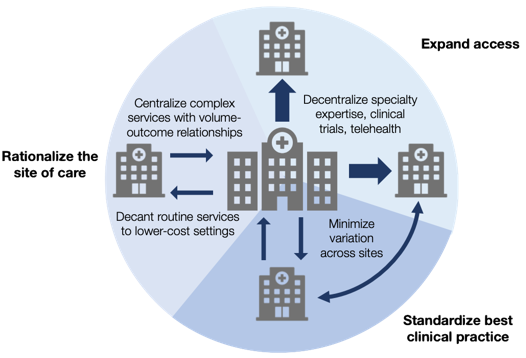
While the framework is still evolving (Figure 1), MVC's early metric prototypes are organized around three ways health systems can uniquely influence value across their sites:

Standardize best clinical practice — minimizing unwarranted variation across sites when the evidence points clearly to what works.

Expand access — decentralizing specialty expertise, clinical trials, and telehealth so patients do not have to travel to get the right care.

Rationalize the site of care — centralizing complex services with well-established volume-outcome relationships, while shifting routine services to lower-cost sites and delivery models.

Figure 1: MVC’s Early Metric Prototype Framework

Diagram illustrating a healthcare strategy focused on rationalizing site of care, expanding access, and standardizing best clinical practice using hospital icons and directional arrows. Key actions include centralizing complex services, decentralizing specialty expertise, minimizing variation across sites, and decanting routine services to lower-cost settings, with labels highlighting each approach.

Dr. Hari Nathan, MD, PhD, Medical Director of MVC, explained the significance of this work:

"The vast majority of hospitals in Michigan belong to a larger health system. While we have historically focused on hospital-level quality improvement, health systems have an opportunity and a responsibility to ensure consistently high quality across their sites…The new MVC Systems VBI is a first step towards providing actionable insights to health systems that wish to understand and improve quality across their hospitals."

Looking Ahead

This initiative marks the beginning of a multi-year effort. MVC intends for it to be shaped by the systems it is meant to serve while continuing to provide traditional service offerings and support for all sites. Opportunities to weigh in will be shared through upcoming presentations, breakout sessions, and networking events. MVC will continue to share updates on this VBI as work progresses.