
Off
View Post
MVC In-Person Networking Event: Continuing the Conversation – A Networking Dinner on System-Level Quality Metrics

MVC In-Person Networking Event: Continuing the Conversation – A Networking Dinner on System-Level Quality Metrics

On June 17, the Michigan Value Collaborative (MVC) welcomed 18 quality leaders representing 16 hospitals across six health systems for an evening of networking and collaborative discussion focused on the future of system-level quality improvement. The event built upon conversations from MVC’s spring collaborative-wide meeting, where participants identified opportunities and goals for measuring quality improvement within and across multi-hospital systems.

The in-person networking dinner provided an opportunity to further engage participants in hands-on activities designed to gather feedback, encourage peer learning, and refine ideas for future MVC reporting and metric design.

Choosing the Right Visualization

The evening began with an interactive exercise focused on data visualization. Participants were greeted by three mock-ups of system-level metric visualizations and prompted to vote on the metric they believed would be most useful to support quality improvement.

Photograph of a silent auction setup with informational signs displayed on a black tablecloth in a well-lit room with wooden floors and brick walls. Signs include a "SYSTEM-LEVEL METRIC" poster with blue and yellow design elements and bar charts showing data trends, while an MVC team member stands in the background near a window.

Pictured above is MVC Project Manager Emily Woltmann, PhD, MSW, standing alongside a display table at MVC’s June 2026 networking dinner

The group overwhelmingly preferred a visualization displaying consistency among hospitals within a health system for a given metric (Figure 1). Discussions with participants revealed that this approach would allow system leaders to quickly identify opportunities for shared learning, recognize high-performing hospitals, and prioritize improvement efforts where variation exists. This reinforced the importance placed on balancing meaningful information with a metric that supports action, as shared during the preceding spring collaborative-wide meeting breakout activity.

Figure 1. System-Level Metric Visualization Mock-Ups

A set of three infographic panels presenting different healthcare measurement ideas: system consistency, access, and site of care rationalization. Each panel includes bar charts with labeled axes and brief explanatory text highlighting variation between hospitals, excess travel distance, and minimum procedure thresholds for complex surgery.

Speed Networking Sparks Perspective

Following dinner, attendees participated in a “speed dating” style networking activity designed to generate diverse perspectives on system-level quality improvement reporting. Each participant received a customized deck of discussion prompt cards covering topics such as preferred benchmarking approaches, desired report features, future quality priorities, and characteristics of an ideal system-level metric (Figure 2).

Figure 2. Sample of Speed Networking Prompt Cards 1-3

Three discussion cards with blue borders and headings labeled "Discussion Card" contain questions and prompts for partner conversations. Each card includes fill-in-the-blank spaces for partner names, multiple-choice or open-ended questions about system comparisons, metric layers, and improvement goals, with checkboxes and lines for written responses.

Every five minutes participants paired with a new colleague, selected a new discussion card, and explored one of the prompts with their partner before rotating again. By the end of the activity, each attendee had connected with six different peers, allowing them to hear perspectives from hospitals and health systems across Michigan while also expanding their professional network.

Photograph of a group of people dining and networking in a restaurant with wooden floors and large windows providing natural light. The setting features dark blue walls, black chairs, and tables with food and drinks, capturing a casual social gathering atmosphere.

Pictured above is a group of healthcare quality leaders at MVC’s June 2026 networking dinner.

The prompt cards encouraged participants to think creatively about questions such as:

  • Should system-level reports compare hospitals with: other hospitals in a multi-hospital system, systems to other systems, or statewide benchmarks?
  • What stratifications would provide the greatest insight into performance variation?
  • What quality outcomes should become the next system-wide priority?
  • What information would make a system-level report most actionable?

These one-on-one conversations generated thoughtful discussion around identifying meaningful measures, balancing accountability with collaboration, and designing reports that support improvement across diverse organizations.

Wrap Up: Identifying Common Themes

The evening concluded with a facilitated group discussion where participants were encouraged to think about recurring themes from their conversations with peers.

Throughout the event, attendees emphasized the value of reports that are easy to interpret, highlight meaningful variation within multi-hospital systems, and provide actionable information. Participants also discussed the importance of thoughtful benchmarking, meaningful risk adjustment, and opportunities to drill down into data to better understand differences in performance. One common theme noted was the continued importance of understanding the variation and impact of non-medical drivers of health.

Perhaps equally valuable was the opportunity this event offered to strengthen relationships among quality leaders from across the state. By encouraging diverse conversations throughout the evening, participants exchanged ideas and made connections with peers they may not have otherwise met, creating new networks that extend across health systems.

One attendee shared:

“It was really nice and planned well. The activity was well thought out and engaging. I think I talked to almost everyone and there was movement. I didn’t know or realize that we could attend these sessions in other regions, and I was happy to connect with other hospitals in attendance…I felt it was worth the drive and time. I appreciate [MVC] planning and hosting it.”

The ideas generated during this networking event will help inform future system-level reporting and metric development within the MVC Coordinating Center. MVC looks forward to hosting additional networking events in the future to further increase collaboration and connection among its members. The next networking opportunity will be offered as an in-person dinner on Oct. 8, the evening before MVC’s fall collaborative-wide meeting. Registration is forthcoming.

Off
View Post
MVC Virtual Networking Event: Leveraging Claims Data for Rural & Critical Access Hospital Quality Initiatives

MVC Virtual Networking Event: Leveraging Claims Data for Rural & Critical Access Hospital Quality Initiatives

On August 21, 2025, MVC Coordinating Center hosted a virtual networking event providing members from rural, critical access, and acute care hospitals with an opportunity to make professional connections and discuss strategies for leveraging claims data. Twenty-three MVC members from twenty different hospitals and eight health systems participated in the ninety-minute event.

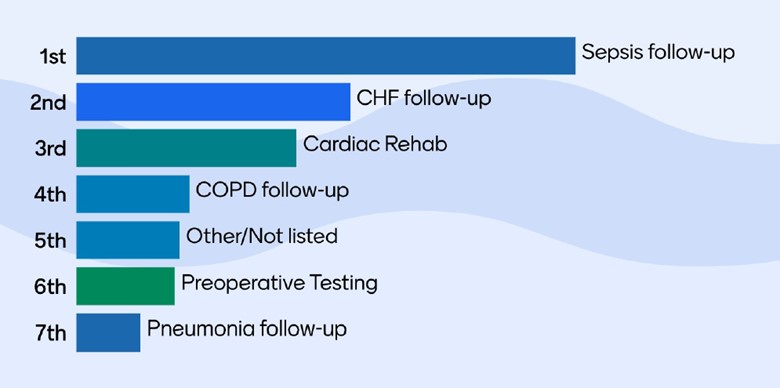
The event began with an ice breaker activity and a brief interactive quiz reviewing the number of and CMS requirements for rural and critical access hospitals (CAHs). This portion of the event concluded with a survey of MVC value metrics most relevant to quality improvement (QI) at rural and CAHs revealing most sites are focused on sepsis follow-up (Figure 1).

Figure 1. Most relevant MVC value metrics to QI at your site
The networking event continued with a presentation by MVC’s Engagement Manager Jessica Souva, MSN, RN, C-ONQS highlighting MVC’s history with critical access and rural hospitals and the addition of ED-based episodes. Starting in 2016, CAHs began joining MVC membership and today twenty-four different CAH sites are active MVC members.

Souva emphasized the need to better serve this group by understanding their unique challenges. She then shared unblinded data on hospital-level index emergency department (ED) visits with behavioral health ICD-10 code rates for 30-day ED-based episodes from January 1, 2021 to November 30, 2024. Prior to sharing the data, members were asked where they thought their hospital’s rate would fall compared to the MVC All average, most felt their rates would be higher than the average. After sharing the data, most members found their rates to be lower than expected.

Aggregate data for conditions with the highest ED episode and inpatient episode volumes across all rural and CAHs from January 1, 2022 to December 31, 2024 were also shared (Figure 2). Souva encouraged members to discuss opportunities for benchmarking and custom analytics during the breakout session with this data in mind.

Figure 2. Conditions with the highest ED and inpatient episode volumes
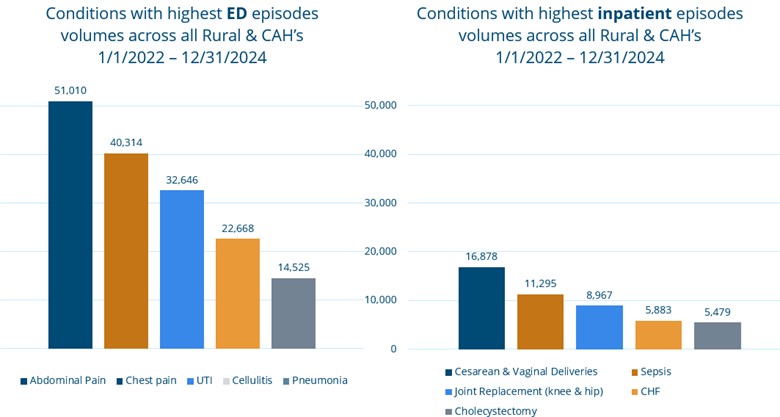
vertical bar graphs of conditions with the highest ED and inpatient episode volumes

The breakout discussions were structured to engage attendees in conversations about the challenges and strategies to address leveraging claims data for rural and CAHs. After breaking into two smaller groups, attendees were provided with three primary discussion prompts to reflect upon:

  1. Data Possibilities: What data sources and metrics are frequently utilized to determine outcomes and impact of process improvements in the inpatient or ED setting?

MVC members reported that various internal data platforms and benchmarking tools such as Vizient, Premiere, and Q-Centrix are used by critical access and rural health sites. They also noted frequently using metrics provided by various collaborative quality initiatives (CQIs) (e.g., HMS, MEDIC, etc.) and Medicare Beneficiary Quality Improvement Project (MBQIP) Core Measure sets to evaluate process improvements. When asked how MVC can optimize benchmarking for rural and CAHs, attendees explored options for comparing data with similar-sized sites and increased alignment between CQI pay-for-performance (P4P) metrics.

  1. Data Sharing: Which stakeholders are commonly engaged in determining strategies and indicators of successful QI initiative implementation?

The discussions in both breakout rooms highlighted the importance of involving clinical leads, physician champions, and quality improvement oversight boards for the success of QIs. One hospital noted that they additionally include an executive sponsor for each QI which they find helps to drive QI forward. Others noted a shift in culture towards encouraging ownership of QI implementation to front line staff. They noted that with adjustments to quality departments’ scope and capacity, quality leadership can focus more on the “why” versus the “how” of QI.

  1. Conditions & Follow-Up Care: Are there specific conditions currently focused on reducing ED return visits and/or inpatient readmissions?

Key conditions of focus identified by MVC members include readmissions, chronic obstructive pulmonary disease (COPD), congestive heart failure (CHF), pneumonia, sepsis and diabetes. When asked if the data shared today inspired interest in new conditions or processes to investigate in the future, members noted interest in continuing to explore the utilization of behavioral health in ED-based episodes.

Feedback from members on MVC’s August Virtual Networking Event included:

  • “I enjoyed participating and sharing during this event.”
  • “This was very helpful. I would love more meetings like this specific to critical access hospitals and small rural hospitals.”
  • “These networking events are always great and provide great insight into what is happening across the state. It allows us to share ideas but there is also a validation component that we are all experiencing a lot of the same challenges and barriers.”
  • “This was a great networking event. As a member of an organization going through multiple ‘changes’, it was awesome to see how larger acute or rural hospitals tend to their QI projects.”
  • “There was a lot of great dialogs about changing culture and how we approach quality improvement.”

MVC looks forward to hosting additional networking events in the future to increase collaboration and connection with MVC’s members. The next networking opportunity will be an in-person networking dinner on October 9, 2025, the evening before MVC’s Fall Collaborative-Wide meeting. If you are interested in attending, please register for this event here. Please note that space is limited.