In December, Michigan Value Collaborative’s (MVC) preoperative testing workgroup featured a co-presentation by Kelly Lewton, RN, BSN, Performance Improvement Coordinator for Lake Huron Medical Center, and Nicole Mott, MD, MSCR, a National Clinician Scholar at the University of Michigan supported by the Veterans Administration and a general surgery resident at the University of Colorado. The presentation focused on the Right-Sizing Testing Before Elective Surgery (RITE-Size) trial; Dr. Mott was the lead author on a recently published paper in JAMA Network Open that described the components and impact of the trial, and Lewton shared her first-hand experience as the lead during Lake Huron Medical Center’s participation in the trial. RITE-Size works with hospitals to identify and right-size testing before elective surgery procedures. The second workgroup, health in action, featured MVC Site Engagement Coordinator Emily Bair, MS, MPH, RDN, CSP, and the Engagement team and focused on a year in review of quality initiatives across MVC members. The MVC Coordinating Center hosts one to two workgroup presentations per month covering a variety of topics including post-discharge follow-up, sepsis, cardiac rehabilitation, rural health, preoperative testing, and health in action.
Preoperative Testing Workgroup - RITE-Size & Lake Huron Medical Center
The RITE-Size trial is a partnership among quality improvement teams in Michigan including the Michigan Program on Value Enhancement (MPrOVE), the MVC Coordinating Center, the Michigan Surgical Quality Collaborative (MSQC), and the Anesthesiology Performance Improvement and Reporting Exchange (ASPIRE). Dr. Mott shared that the goal for RITE-Size participants is to lower unnecessary preoperative testing before elective outpatient cholecystectomy, inguinal hernia repair, and lumpectomy. Routine preoperative testing before these low-risk surgeries has shown no clinical benefit to the patient but has led to multiple downstream consequences such as increased spending, care cascades, and treatment delays (Dossett & Wilkinson, 2022).
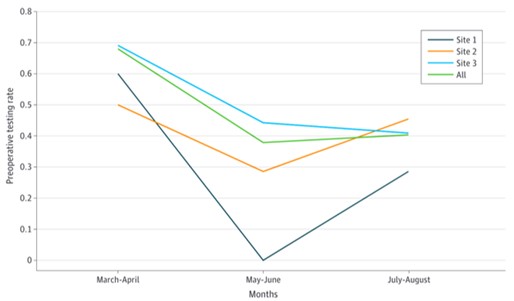
Dr. Mott described that RITE-Size launched a pilot feasibility study in March 2024 at three hospitals in Michigan. The study aimed to meet criteria in several areas such as feasibility (implementation in the appropriate amount of time), testing rates (reduction), and acceptability and appropriateness (results from interviews). By August 2024, the desired milestones had been achieved, showing a 68% reduction in unnecessary testing at all participating sites (Figure 1).
Figure 1. MVC RITE-Size Pilot Program Testing Rates Over Time Across All Three Sites from March-April 2024 to July-August 2024
Some barriers that impacted the study included lack of clarity about guidelines, a need for ongoing education due to the automated nature of testing processes, and coordination across a large healthcare system and/or within the limitations of institutional rules. Elements that led to success included strong leadership through key collaborators, incorporation of the initiative into policy, self-monitoring throughout, and team cohesiveness and communication. The pilot's success allowed RITE-Size to expand to other sites across Michigan.
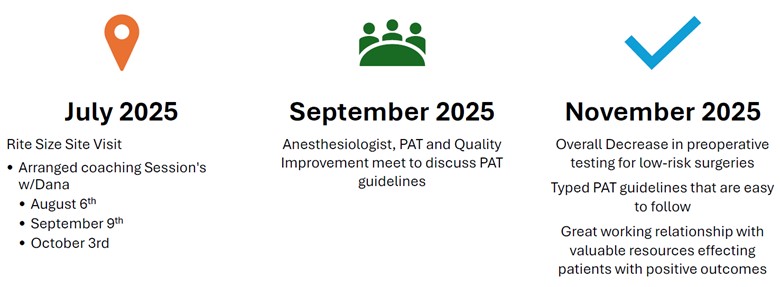
Lewton from Lake Huron Medical Center (LHMC) followed the RITE-size presentation sharing first-hand experience of participating with the initiative in 2025. She described the site onboarding process, which included a RITE-Size site visit in July 2025 where her team worked with Dana Greene, Jr., Project Manager at MPrOVE, to discuss LHMC interventions and progress over the duration of the program and to schedule ongoing coaching sessions (Figure 2). After investigating preoperative testing rates, LHMC found that their biggest outlier was electrocardiograms (EKGs) ordered by a particular surgeon.
After the site visit, the lead anesthesiologist met with the surgeon, and they discovered he had been given outdated testing guidelines when he onboarded. With this discovery, their team was able to review their testing guidelines and begin the process of updating and educating team members. By November 2025, LHMC saw a notable decrease in preoperative testing for low-risk surgeries and began development for an updated version of their pre-admission testing (PAT) guidelines.
Figure 2. LHMC Timeline of RITE-Size Pilot Work
Lewton rounded out the presentation sharing that the RITE-Size project helped LHMC to update their care guidelines, improve patient care, and reduce unnecessary testing. RITE-Size also provided many resources for staff to help with new process implementation and coached staff to use evidence-based research to guide everyday practice.
MVC Preoperative Testing Workgroup: Dec. 2, 2025
Health in Action Workgroup - MVC Coordinating Center
This month’s health in action workgroup was led by MVC Site Engagement Coordinator Emily Bair, MS, MPH, RDN, CSP, with support from other staff at the MVC Coordinating Center. The workgroup encapsulated a year in review for member QI work in 2025 as well as a look ahead at 2026.
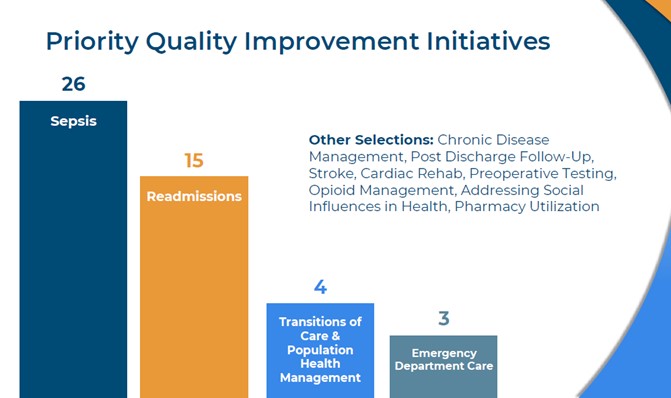
Bair shared result highlights from the MVC QI survey that many MVC members completed in June 2025, noting several common QI efforts across the state (Figure 3). The top areas of focus were sepsis, readmissions, transitions of care, population health management, and emergency department care. Of the 88 survey responses, there were a total of 65 hospitals, 8 physician organizations, and 15 hospital systems represented.
Figure 3. Statewide QI Initiatives in 2025
Some of the common barriers identified by member sites in the survey included insufficient resources and funds, staff burnout, high turnover, and staff shortages.
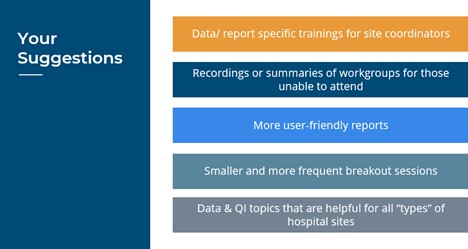
The MVC QI survey also sought to consider the needs of its members and asked participants to provide suggestions for how MVC can best support them in the upcoming year (Figure 4). The top requests included data and report-specific training, recordings and summaries of workgroups for those unable to attend events, user-friendly reports, smaller and more frequent breakout sessions during virtual events, and data and QI topics that are helpful for all types of hospital sites.
Figure 4. MVC Member Suggestions for Future Offerings
Bair reminded participants that MVC uploads virtual workgroup recordings to MVC’s YouTube channel and shares the link with members in a post-workgroup summary email along with slides and resources from presentations. To support members in accessing additional training opportunities, MVC has launched its new new site coordinator education program in January 2026. The four-module training is designed to provide a more individualized approach to building knowledge as an MVC site coordinator. The MVC QI survey was also a helpful resource for presenter recruitment, developing 2025 workgroup content, and planning 2026 offerings.
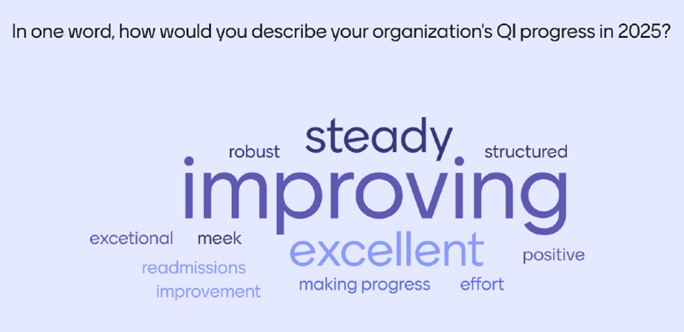
Following the 2025 review, participants engaged in an interactive polling activity about QI progress from the past year (Figure 5), areas of focus, and their key accomplishments. Some of the successes shared included improving compliance with the sepsis bundle, maintaining a low readmission rate, increased senior/executive leadership engagement, and a department-led change to improve utilization.
Figure 5. MVC Participants QI Progress Word Cloud
Workgroup participants were asked to share some of their QI priorities for 2026, including ways that their sites are trying to align with other services or programs and how MVC can best support them. Several shared they will focus on the following priorities in 2026:
- Sepsis compliance improvement
- Streamlining order sets to reduce sepsis fallouts
- Reducing readmissions
- Building connections with primary care clinics
- Reducing length of stay
- Reducing unnecessary preoperative testing by participating in the RITE-Size trial
- Reducing hospital acquired infections
- Interviewing readmissions patients
Participants also shared different ways they are working to align with Collaborative Quality Initiatives (CQI) and Centers for Medicare & Medicaid Services (CMS) measures. Several sites noted that they are shifting to align their sepsis metrics with the Michigan Hospital Medicine Safety Consortium (HMS) sepsis initiative and the CMS Hospital Sepsis Program Core Elements.
Members expressed interest in learning more about local quality leaders, developing effective committee structures within their sites, and acquiring new resources that might be available. Additionally, there was great interest in MVC’s new site coordinator education program that kicked off this January with modules that support site coordinators via one-on-one tailored training. Registration for the education program is closed for Q1 – Q2, and a waitlist has been started for Q3 – Q4. If you are a site coordinator interested in participating, you can submit an interest form. [LINK]
MVC welcomes workgroup presenters from across Michigan to share their expertise, success stories, initiatives, and solution-focused ideas with MVC members. Please reach out to us by email or by submitting a presentation proposal here if you are interested in sharing your work in a presentation.