
Quality improvement often starts with a clinical question, such as where are opportunities to improve care, what factors may be contributing to variation in outcomes, and how can providers use that information to guide changes in practice? The Michigan Value Collaborative (MVC) frequently partners with its peer Clinical Quality Initiatives (CQIs) to help answer these questions, combining statewide claims data and MVC analytic expertise with the clinical knowledge and specialty-specific focus of CQI partners.
One example of these partnerships is MVC's ongoing collaboration with the Michigan Urological Surgery Improvement Collaborative (MUSIC) on its work to improve care for patients undergoing procedures for benign prostatic hyperplasia (BPH). MUSIC has leveraged MVC claims data to better understand statewide patterns in BPH care, investigate variation in surgical approaches and post-procedural outcomes, and identify opportunities to improve the value of care delivered across its network of urology practices.
Using Claims Data to Better Understand BPH Care
MUSIC was established in 2011 to improve patients’ lives through high-quality care and cost efficiency of urologic treatments (read MUSIC spotlight blog from 2025). At its inception, the initial focus of MUSIC was improving care for patients diagnosed with or at risk of prostate cancer. MUSIC further expanded its focus from prostate cancer (MUSIC-Prostate) to a program focused on kidney stones (MUSIC-ROCKS) in 2016 and small kidney tumors (MUSIC-KIDNEY) in 2017. Most recently, MUSIC added a new program focused on BPH in the fourth quarter of 2025.
BPH, a common condition involving enlargement of the prostate, can cause lower urinary tract symptoms and may require surgical intervention when other treatment approaches are insufficient. Although several procedural options are available, understanding how patients fare following these procedures, including their subsequent healthcare utilization and costs, is important to informing clinical decision-making and identifying opportunities for improvement.
To advance MUSIC’s new BPH program, MUSIC partnered with MVC. By combining MVC’s claims data and analytic expertise with MUSIC’s clinical knowledge and statewide network of urology practices, the partnership developed a comprehensive picture of BPH care including procedure trends, emergency department visits, hospitalizations, outcomes, and episode payments. These insights help MUSIC identify variation in care, better understand the factors driving post-surgical utilization and costs, and pinpoint meaningful opportunities for improvement.
Recent Publications Add to Collective Insights into BPH Care
A recent publication in the Journal of Urology highlights one example of how this partnership is advancing the understanding of BPH surgical outcomes. Published online on Oct. 22, 2026, Initiation of Medical Therapy for Storage Lower Urinary Tract Symptoms After Benign Prostatic Hyperplasia Surgery used MVC statewide claims data from 2017–2022 to examine the initiation of medications for storage lower urinary tract symptoms following BPH procedures.
The investigation included 11,519 patients who had not previously used the medications examined and underwent one of nine contemporary BPH procedures. The MUSIC team evaluated the likelihood of patients initiating anticholinergic or beta-3 agonist medications between three and 12 months following surgery. Medication initiation was relatively uncommon across procedures, with 12-month rates ranging from 5.7% to 11%. However, the findings identified differences by procedure type. Laser photovaporization (PVP) was associated with a higher likelihood of medication initiation compared with transurethral resection of the prostate (TURP), even after accounting for other patient- and procedure-level factors.
These findings offer real-world benchmarks that may help urologists counsel patients about potential outcomes following different BPH procedures. More broadly, this analysis demonstrated how statewide claims data can help investigate clinical questions that may be difficult to answer through individual practice-level data alone.
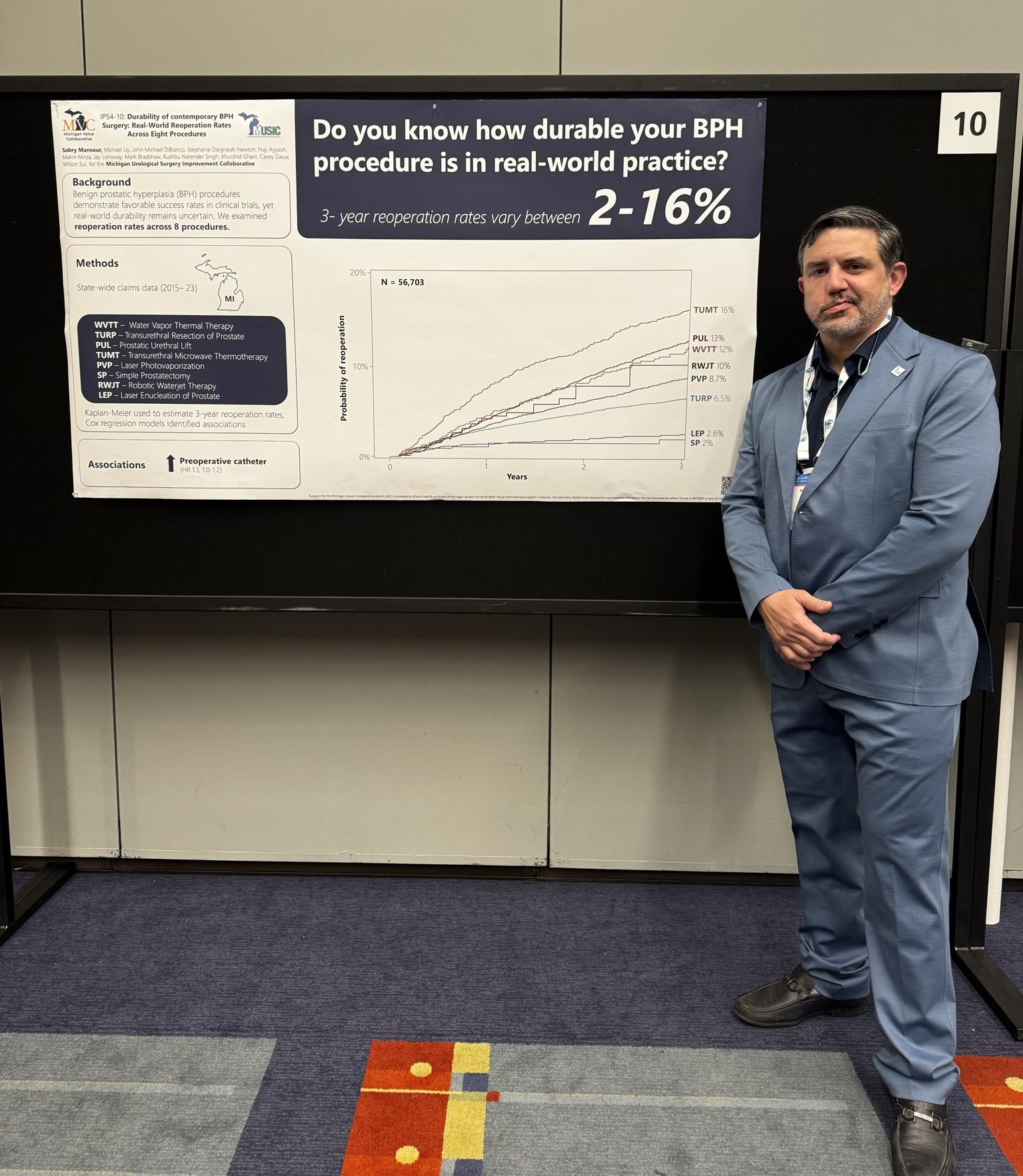
The urology community has embraced this work. The MUSIC-MVC data collaboration has led to publications in the Journal of Urology as well as presentations at key events. The BPH team presented at the 41st annual European Association of Urology (EAU) Congress in London, which resulted in an award for best abstract presentation for "Unplanned Healthcare Utilization after Benign Prostate Intervention in Michigan" (Michael Uy et al., 2026). They also presented a session at the 2026 American Urological Association (AUA) meeting on BPH surgical therapy and new technology, along with a poster titled "Durability of Contemporary BPH Surgery: Real World Re-Operation Rates Across Eight Procedures" that won best poster (Figure 1).
Figure 1. Dr. Sabry Mansour, MUSIC BPH Program Co-Director, presenting the award-winning “Durability of Contemporary BPH Surgery: Real-World Reoperation Rates Across Eight Procedures” poster at the 2026 AUA Meeting
Extending the Impact of MVC Data through Ongoing CQI Partnerships
The BPH collaboration is one example of how MVC data can support improvement efforts across a variety of clinical specialties and service lines. By pairing its statewide claims data and analytic capabilities with the clinical expertise and established provider networks of CQI partners, MVC extends the reach of its data to drive high-value care delivery beyond its membership.
MVC has supported 67 partner projects with collaborating CQIs thus far in 2026, including 34 supported by the MVC Coordinating Center via ongoing data consultation or direct analytic support. These collaborations continue to create opportunities for MVC and its CQI partners to investigate important clinical questions, translate data into actionable insights, and support quality improvement across Michigan.
The BCBSM-funded CQIs play a crucial role in driving healthcare quality improvement, and MVC is excited to continue showcasing the innovative contributions of individual CQIs and the ways in which MVC’s data support high-value care initiatives across the portfolio. Please reach out to MVC by email if you are interested in learning more.