In September, the Michigan Value Collaborative (MVC) hosted a sepsis workgroup featuring a presentation by McLaren Flint Hospital highlighting their sepsis improvement journey. The MVC Coordinating Center hosts workgroup presentations once or twice per month, covering a variety of topics including cardiac rehab, post-discharge follow-up, sepsis, rural health, preoperative testing, and health in action. View the full 2027 MVC event calendar here.
Sepsis Workgroup: McLaren Flint Hospital
During this month’s sepsis workgroup, Kerri Tomasi-Herman, RN and Ali Arthur, BSN, RN, CCRN, Quality Improvement Specialist RNs at McLaren Flint, presented on the hospital’s work to strengthen sepsis processes over the past two years. Their presentation offered practical examples of how the team has used dashboards, daily auditing, nursing checklists, provider education, and interdisciplinary collaboration to address sepsis performance challenges.
McLaren Flint is a 378-bed hospital and Level III Trauma Center with high emergency department and inpatient volumes. Tomasi-Herman and Arthur began their presentation with a description of a significant transition in sepsis quality improvement beginning in 2025.
Previously, McLaren Flint relied on an on-site clinical abstractor and sepsis coordinator who reviewed sepsis patients, supported completion of the Centers for Medicare and Medicaid Services (CMS) sepsis bundle, and provided real-time assistance to nurses and providers. While they acknowledged this role as an important resource, the team recognized that relying heavily on one individual could mask underlying process issues.
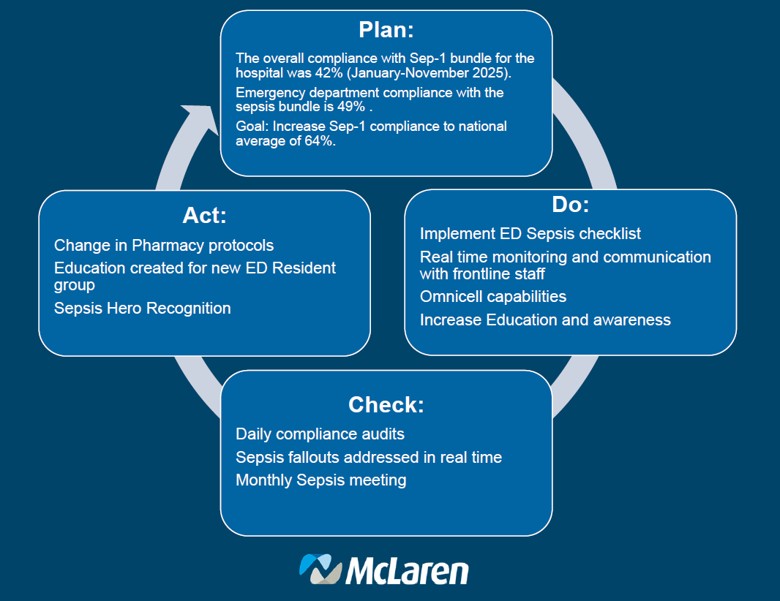
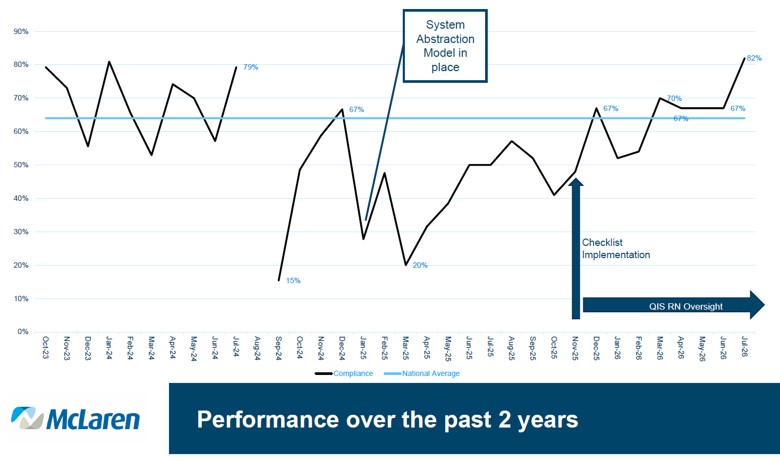
In 2025, McLaren centralized sepsis abstraction across the hospital system. This shifted the role of the local quality improvement team toward real-time monitoring, intervention, feedback, and use of data to drive improvement.
Figure 1. McLaren Flint’s PDCA Cycle Approach to Sepsis Improvement
Using Dashboard Data to Identify Opportunity for Improvement
Considering this shift towards real-time monitoring, a tool Tomasi-Herman and Arthur highlighted as key to their new workflow was the McLaren sepsis performance dashboard. The dashboard allows the quality team to see overall compliance as well as performance across different areas, including the emergency department (ED) and inpatient units.
The team uses this information during its monthly sepsis and quality improvement meetings across various clinical areas. Pareto charts help identify the most common causes of sepsis measure fallouts by service area to further pinpoint opportunities for improvement. This more detailed breakdown allows the team to tailor improvement strategies to specific departments and processes. For example, using this data they have found that within the ED, antibiotic administration most commonly contributes to sepsis fallouts, while for inpatient the most common issue is timely initial lactate orders.
The presenters emphasized that making this information visible to providers and hospital leaders has helped create greater awareness of performance and opportunities for improvement. McLaren Flint’s sepsis committee currently includes representatives from quality, medical staff, nursing, emergency medicine, intensive care unit, pharmacy and laboratory services with additional participants engaging when a specific fallout involves their department.
Figure 2. McLaren Flint’s Sepsis Performance Over the Past 2 Years
Real-Time Monitoring Helps to Avoid Fallouts
Another major component of McLaren Flint’s approach is daily real-time monitoring. Each morning, the quality improvement team reviews their internal electronic medical record (EMR) sepsis worklist, which identifies patients meeting sepsis-related criteria. The team then follows patients in real time, monitoring whether appropriate orders for blood cultures, antibiotics and other elements of the bundle are completed.
When a potential delay is identified, the team provides real-time reminders to appropriate nurses and providers. They also review cases retrospectively and send follow-ups or documentation addendum requests when appropriate. This combination of real-time intervention and retrospective review allows the team to address individual cases while also identifying recurring process issues.
Reviewing individual fallout cases minute-by-minute offers the opportunity to determine whether the underlying issue was related to workflow, documentation, laboratory processes, or another factor. One example provided by the presenters involved antibiotic orders that were not being reviewed quickly enough by pharmacy. After identifying and bringing this item to the attention of the sepsis committee, the pharmacy department adjusted its process to prioritize validation of antibiotics associated with sepsis and infection-related orders. Since this process has changed, the turnaround time for medication validation has decreased to less than 10 minutes.
Introduction of ED Sepsis Checklist
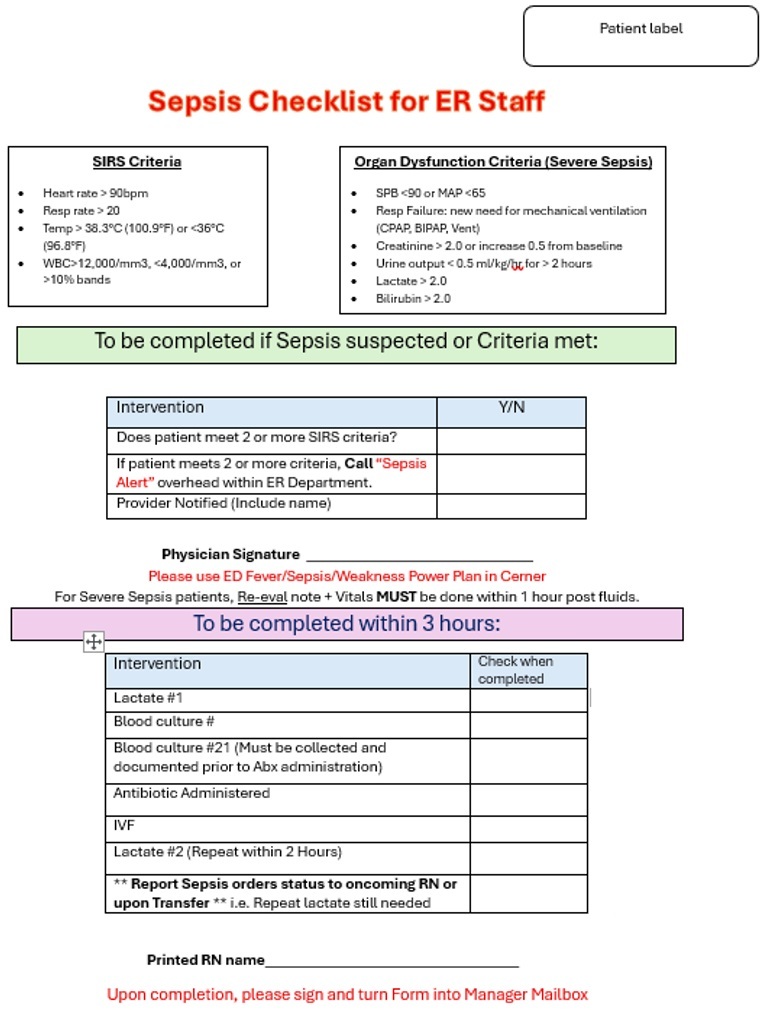
Because McLaren’s EMR system does not include a built-in sepsis nursing flowsheet or navigator, the team decided to design a paper-based tool. McLaren Flint implemented this sepsis checklist first within their ED. The checklist highlights systemic inflammatory response syndrome (SIRS). SIRS criteria checks for organ disfunction and is intended to prompt nurses to bring potential sepsis concerns to their physician as early as possible.
The checklist has gone through several revisions based on feedback from frontline staff. Together, they have worked to create a simplified tool that functions as a practical guide for nursing staff. These checklists are collected at the end of shifts and compared to patients identified through the EMR worklist to monitor utilization and compliance among staff.
Figure 3. McLaren Flint’s Sepsis Checklist for Emergency Room (ER) Staff
Engagement of Frontline Staff
In addition to engaging frontline staff with the development of the sepsis checklist, McLaren Flint shared a creative strategy for building engagement: the Sepsis Hero Award.
This award was revived to recognize nurses and providers who demonstrate strong sepsis performance and engagement. A recent recipient was acknowledged for high checklist compliance, positive attitude, and having no sepsis fallouts.
This recognition has become a source of positive competition among ED staff, with team members becoming increasingly interested in being recognized for their contributions. This demonstrates the power recognition can have on complimenting data and education by making improvement efforts visible and celebrating frontline participation.
Looking Ahead to Continuous Improvement
Near the end of the workgroup, Tomasi-Herman and Arthur reflected that while McLaren Flint has made great progress, they continue to identify areas for improvement. One challenge they have identified is that their EMR-based automated sepsis alerts do not always align with CMS sepsis requirements, resulting in some false alerts. They have also identified limitations to their EMR configuration and opportunities to strengthen the recognition of sepsis patients receiving care on inpatient floors, particularly when a patient’s condition evolves after admission.
Looking ahead, McLaren Flint plans to continue educating ED staff, including their new medical resident program, promote standardized sepsis documentation, and monitor inpatient sepsis alerts. The team is also working to recruit frontline nurses or providers to serve as sepsis champions and participate in monthly sepsis meetings, continuing to bring frontline perspectives into the hospital’s quality improvement work.
Key Takeaways for MVC Members:
McLaren Flint’s presentation offered several practical strategies that other hospitals may consider when aiming to strengthen their sepsis improvement efforts:
- User performance data to identify specific process opportunities – rather than relying solely on compliance rate
- Pair real time monitoring with retrospective review – to address potential gaps before they become measurable fallouts
- Create simple frontline tools – when EHR functionality does not fully support a desired workflow
- Celebrate staff contributions – through recognition and awards
- Bring multiple disciplines together – to identify and address system-level barriers
- Share performance transparently – with providers, managers, and clinical leaders to build awareness and accountability
MVC Sepsis Workgroup: Sept. 15, 2026
MVC welcomes workgroup presenters from across Michigan to share their expertise, success stories, initiatives, and solution-focused ideas with MVC members. Please reach out to the Coordinating Center by email if you are interested in being a workgroup presenter or submit a presentation proposal here.